Cd'A mining company finds rare mineral deposit
Discovery of yttrium element may support aerospace, defense, semiconductor manufacturing

Travis Swallow, of Idaho Strategic Resources, says demand for a domestic supply of rare earth element yttrium is increasing.
| Matt StephensCoeur d'Alene-based Idaho Strategic Resources Inc. is drawing attention from technology and aerospace manufacturers looking for a domestic supply of yttrium, one of the world's most strategically important rare earth elements, says Travis Swallow, director of investor relations and corporate development for the North Idaho gold producer.
Through early exploration by the mining company at its 4,900-acre Diamond Creek project near Salmon, Idaho, company geologists have identified unusually high concentrations of yttrium, a heavy rare earth element used in semiconductor manufacturing, aerospace components, defense systems, and other advanced technologies, Travis says.
The discovery comes as U.S. manufacturers continue searching for alternatives to Chinese supply chains after years of export restrictions and geopolitical uncertainty. China remains the dominant global supplier of heavy rare earth elements, leaving many American manufacturers vulnerable to disruptions, Travis explains.
Market instability and a lack of domestic supply steered Idaho Strategic Resources into exploring the rare earth sector.
"We jumped into the rare earth industry in about 2020, right at the onset of COVID," Travis says. "We had seen what was going to happen with supply chains. We couldn't even get masks from China during COVID, but we knew where all of our rare earth elements were coming from."
The company entered the rare earth exploration business by staking claims across central Idaho before supply chain concerns became a national priority, Travis says. Since then, geologists have completed mapping, surface sampling, geophysical surveys, and trenching to identify drilling targets at the Diamond Creek property, which lies within Idaho's rare earth and thorium belt.
John Swallow, president and CEO of Idaho Strategic Resources, says the nation's critical mineral shortage reflects decades of offshoring manufacturing and resource production.
"We're coming out of a 40-year cycle where we globalized and offshored the production of just about everything," John says. "Now everybody is realizing we have to bring domestic production back."
Idaho Strategic Resources currently employs 70 full-time workers, including five administrators in its Coeur d'Alene office and six geologists working from a field office near Salmon. The majority of its workforce supports its gold mining and milling operations near Kellogg, Idaho, Travis says.
According to a March press release, the company pulled in a record $42.4 million in revenue in 2025, a 65% increase from the year prior.
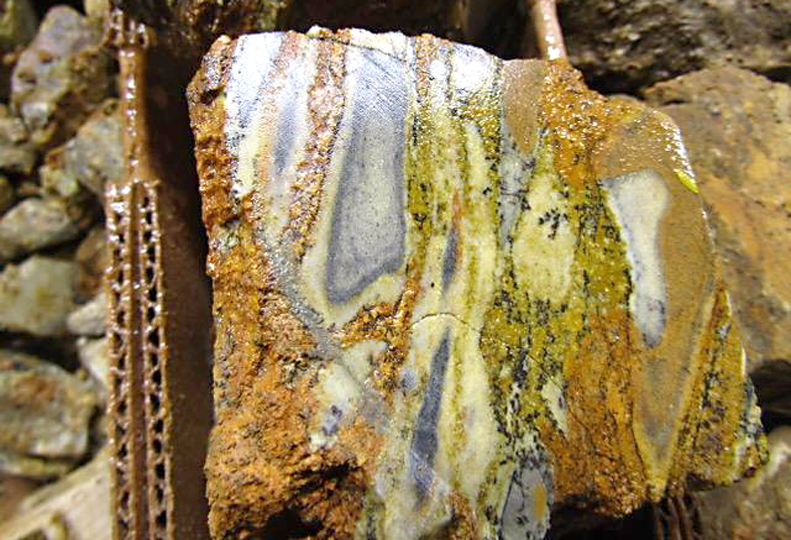 Mineral sample taken in the Diamond Creek location containing rare earth metal yttrium. Idaho Strategic Resources
Initial exploration has consisted of one trench and one drill hole, but both returned encouraging yttrium values, Travis says.
"The sample purity in Diamond Creek is significantly higher than other findings on American soil," Travis contends.
Although the project remains in its early stages, Travis says the results have already attracted interest from major technology companies seeking reliable domestic suppliers.
One semiconductor manufacturer, which Travis declines to name, contacted Idaho Strategic Resources because it currently relies on Japanese suppliers for yttrium used in thermal barrier coatings applied to computer chips. The company estimates it has about two years of supply remaining before it will need another source, Travis says.
"They're looking for a domestic source. They don't want to put themselves back in a situation where they're dependent on somebody who could be affected by supply disruptions in the future," Travis says.
The manufacturer would require only about 15 to 20 metric tons of yttrium annually, but Travis contends the material is critical because the alternative is redesigning the coating system, which he says would cost hundreds of millions of dollars and require customer qualification.
The same properties that make yttrium valuable in semiconductor manufacturing also make it important to aerospace and defense applications, he says. Yttrium-based ceramic coatings help protect jet engine components, turbine blades, and hypersonic systems from extreme temperatures, while other yttrium compounds are used in advanced electronics, lasers, and specialized alloys.
Continued demand from aerospace, electric vehicle, semiconductor, and emerging humanoid robotic manufacturing is expected to support long-term growth for the mineral, Travis explains.
Several Spokane-area manufacturers operate in industries that depend on materials containing yttrium or other advanced rare earth elements, although most do not purchase the raw mineral directly, Travis says. Manufacturers such as Kaiser Aluminum, for example, produce components destined for aircraft and defense platforms where yttrium-containing thermal barrier coatings and advanced electronic systems are commonly used, Travis says, noting that yttrium demand is increasing.
One of Diamond Creek's advantages is its mineralogy, the study of chemical composition, internal crystal structure, physical and optical properties, and overall formation process of minerals. Travis explains the project's rare earth elements occur primarily within phosphate minerals known as xenotime and monazite, both of which already have established processing methods.
"We use a traditional solvent extraction process," Travis says. "But we can't sell raw ore to manufacturers, so it gets sent out for processing, and eventually makes it to manufacturers."
The company has been working with Idaho Falls-based Idaho National Laboratory on processing studies designed to demonstrate how ore from the project could move from raw material to finished rare earth products, and Travis says the laboratory's expertise could help bridge the gap between mining and downstream manufacturing.
Idaho Strategic Resources expects to continue exploration through 2027. If drilling continues to expand the deposit and commercial partnerships advance, the company could begin transitioning toward mine development within the next several years, Travis explains.
Growing involvement from the private industry gives John confidence that domestic supply chains will continue developing, even if government permitting and policy changes take time.
"I think the industry is more than willing to go try to figure it out," John says. "We're Americans, and Americans eventually figure it out."