Financial industry closes adviser gaps
INW firms embrace new business models centered on mentorship, education
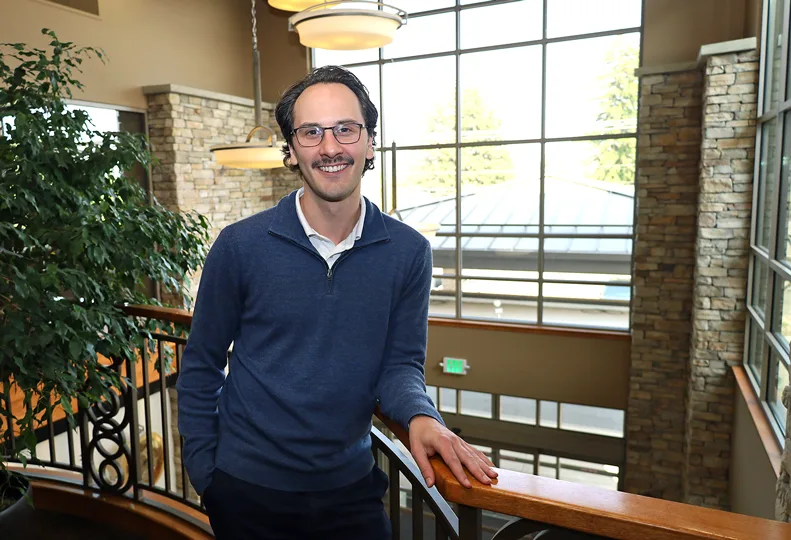
Marcus Holzschuh, president of the Financial Planning Association of Spokane, says many firms are adapting their business models to attract and train new advisers.
| Karina EliasSpokane’s financial planning workforce is showing resilience as firms, educators, and professional organizations develop new strategies to recruit and keep people in the field.
Efforts addressing the industry’s workforce challenges include succession planning, new educational pipelines, salaried career paths, and mentorship models designed to attract and retain the next generation of financial planners. Nationwide, the industry is facing a 100,000-adviser shortage by 2034, according to a report by management consulting firm McKinsey & Co. Statewide, the Washington State Employment & Security Department reports financial planning as one of the fastest-declining professions between 2023 and 2028.
As the industry works to address its workforce challenges, Whitworth University's Master of Science in Financial Planning program, launched in 2023, has become a key pipeline for new advisers. Designed to prepare students for the Certified Financial Planner exam, the program acts as a hub for prospective students as the only such program in a seven-state region, says Robin Henager, founding faculty of the master’s in financial planning program at Whitworth University.
“Each year we’ve met our revenue projections, so it’s grown each year and we’ve filled our classes,” she says. “We started with 12, then 15, and then 20. We’ve capped our program at 20, and we’re very happy that we’ve met those goals.”
Henager contends the industry’s shrinking workforce is driven by retirements and an outdated perception of the profession that deters younger people from entering it. The profession has become less transactional and more relationship-driven, with advisers spending as much time understanding clients’ values and life goals as they do discussing investments, she says.
Marcus Holzschuh, associate investment adviser with Spokane-based Vickerman Investment Advisors Inc., concurs with Henager, noting that the profession has changed faster than public perception of it. Financial advisers typically evoke images of stockbrokers, cold calls, commissions, and aggressive sales, he says, while in reality, the profession has evolved to focus on relationships, planning, coaching, and long-term advising.
“If you say financial adviser, people equate that with 'The Wolf of Wall Street,'” says Holzschuh, who also serves as president of the Financial Planning Association of Spokane. “That old bygone era is not how most any shop does business now.”
As the profession has evolved, so has its compensation model. For decades, entering the financial planning field meant competing in a commission-based environment, Holzschuh says. Many firms would hire advisers on commission and expect them to quickly build a book of business by bringing in clients and assets. Those who couldn’t generate enough commissions often left the profession within a few years, producing significant turnover.
More firms now are choosing to hire new advisers into salaried positions offering bonuses tied to company or individual performance, Holzschuh says. Young advisers often start as interns, paraplanners, or associate advisers, learning the profession under experienced planners before managing their own client relationships. Additionally, many employers are investing in their employees by paying for certification coursework, as well as exam preparation, licensing, and continuing education.
This broader shift toward salaried, mentorship-based roles is being actively implemented by firm owners here who have witnessed the industry’s transformation up close.
Robert Forster, founder of Spokane-based Forster Financial Inc., says he entered the industry in the early '90s and has seen firsthand the evolution from transaction-driven sales to a relationship-based financial planning profession. Today, he has structured his firm around mentoring the next generation of financial advisers by recruiting graduates from Whitworth University’s master’s program, serving on the program’s advisory board for the past three years, and investing time training young professionals before they build their own client practices.
“That usually takes two to four years with us,” Forster says. “But it gives them the time to build some knowledge and some credibility, and then we teach them how to actually build their practice within our firm. I wish every company operated this way.”
Forster acknowledges that the business model is costly; he typically does not see a profit from new hires for the first three to four years. However, once adequately trained, they are better prepared to go out and meet clients. Additionally, some of the younger advisers he has trained over the years have become partners in the firm or are on the path to partnership; a succession plan built around preserving the culture and legacy at the company, he explains.
“I’m a real big advocate in this young talent,” Forster says. “I take care of them; they get a 401(k) and benefits. I could probably do a lot better financially if I did not do what I do, but I’m happy, and I want to keep the legacy going of our firm.”
Travis Messinger, a wealth adviser at Spokane-based Fulcrum Financial Group LLC, says he sees the current industry as ripe for new advisers looking to enter a business with a succession plan in place that allows them to grow and eventually become a partner. In his 10 years in the industry, Messinger has observed employment models shift to a structured career path for new advisers built around a team environment that offers mentorship to newcomers without the immediate pressure of bringing in new business.
“It’s a huge opportunity for new advisers, or consolidation,” he says. “I’m hopeful for the future.”
Having a salaried role is another important factor among career changers transitioning into the financial planning field. Brandon White-Szep, a graduate of Whitworth’s master’s program, says he changed careers to financial planning in 2024, following years of working in project management. He sought to work for firms that offered a base pay while beginning the master's program at Whitworth.
“It did wonders for me,” he says of his studies at Whitworth. “It’s an opportunity to learn from not just educators but people in the industry.”
Today, White-Szep, who works at the Bellevue office of Denver, Colorado-based Mercer Advisors Inc. and holds a residence in Spokane, says the relationship side of financial planning is the most valuable aspect of the profession.
As older professionals retire, White-Szep says the sector offers young people and career changers an opportunity to step in to the field.
Whitworth is adapting its master's program to prepare more students for the profession. Earlier this year, the university received a multiyear, six-figure grant from the Charles Schwab Corporate Foundation to expand coursework focused on career pathways, practice management, and sales and negotiation, Henager says.
The new coursework is intended to help students better understand the many ways to enter and build a career in financial planning.
“I think the problem is awareness,” Henager says. “We really need to get the word out that this is a great profession.”