Veteran entrepreneurs find support in Spokane
County's resource network helps former service members pursue variety of careers, skilled training
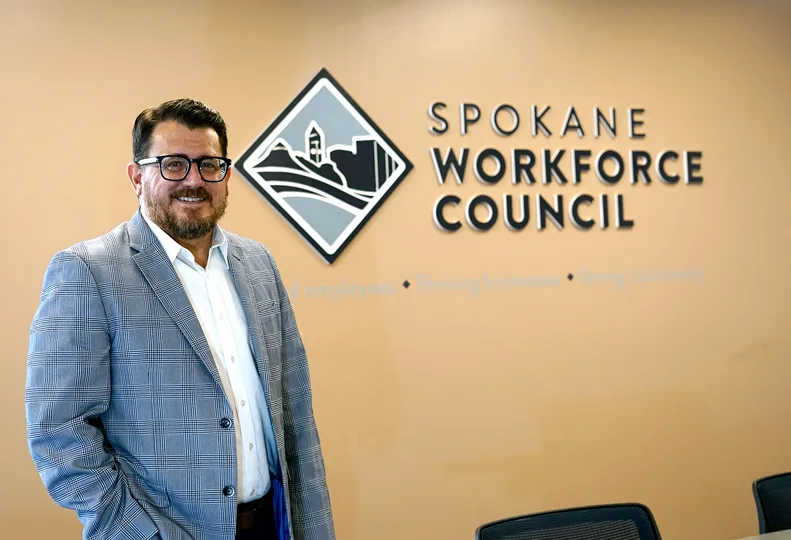
Kevin Williams took over as CEO of Spokane Workforce Council in May.
| Matt StephensSpokane County's large military and veteran community is helping sustain a significant network of veteran-owned businesses, with organizations here that are working to connect former service members with the resources needed to start and grow companies.
Over 40,000 veterans live in Spokane County, according to U.S. Census Bureau data. The national average for areas similar in size to Spokane County is about 26,000 veterans, according to labor market data from Spokane Workforce Council.
Spokane County’s higher concentration of veterans is tied in part to Fairchild Air Force Base and a broader military network that gives service members reasons to remain in the region after leaving active duty, says Kevin Williams, CEO of Spokane Workforce Council.
“I think Spokane County does it better than most places,” Williams says of the region’s support for veterans. “We have a very active and positive veteran network."
The county has about 2,200 veteran-owned businesses or self-employment ventures, Williams says. Not all of those entities are traditional companies with storefronts and employees, and includes sole proprietors, limited liability companies, home-based businesses, online operations, gig work, and other forms of self-employment, he notes.
Regardless of how veteran business ownership is defined, Williams says Spokane County has characteristics that make it particularly attractive to veterans interested in building careers or businesses. Fairchild plays an important role. Some service members finish their military careers at the base and remain in the Inland Northwest, while others migrate to Spokane after separating from military installations elsewhere, he says.
Access to U.S. Department of Veterans Affairs healthcare and military facilities also provides an incentive for veterans to stay in the region, he adds.
As a retired Air Force veteran, Williams says he understands that transition firsthand. He previously served as superintendent of the 92nd Aerospace Medicine Squadron 10 years ago, before joining as CEO of the Spokane Workforce Council in May.
Spokane’s healthcare sector provides one example of how military skills can translate directly into civilian careers, says Williams, who has seen numerous former Fairchild personnel move into jobs with regional healthcare providers after leaving service.
That career path, however, could also help explain a broader national shift away from veteran entrepreneurship.
Veteran business ownership slipped from about 11% of businesses in 2014 to 8.1% in 2020, according to data from the U.S. Small Business Administration Office of Advocacy. An aging veteran business-owner population accounts for part of the decline as owners age into retirement.
The military creates additional career opportunities outside of entrepreneurship, which could account for the decline in veteran businesses opening nationwide, Williams says.
“I think that because veterans are a hot commodity in the workforce because of the various skills that they have, both technical and durable, I think that it’s a tough decision for them to make,” Williams says.
For instance, a veteran might decide to take a well-paying position for several years before pursuing business ownership, particularly when starting a company requires an upfront financial investment and carries greater risk, he says. Technology also allows some people to combine the two paths by working a traditional job while developing a business on the side.
For veterans choosing entrepreneurship in the Spokane area, Williams says there's no shortage of resources and more could be done to help people navigate them.
“It’s not a matter of we don’t have enough resources in Spokane County to help an entrepreneur and a veteran-owned business,” Williams says. “It’s trying to connect them to the right path for each individual.”
StartUp Spokane is among the resources Williams recommends. The program is a partnership between Spokane Public Library and Spokane County Library District designed to connect entrepreneurs with business information, planning assistance, data, mentorship, research tools, and other resources.
Someone interested in opening a towing company, for example, might need to determine what equipment to purchase, what licensing is required, how to obtain capital, and whether the market here can support the company, Williams explains. StartUp Spokane can help an entrepreneur answer those questions, Williams says.
Other resources include the U.S. Small Business Administration, Score, multiple regional chambers of commerce, and economic development organizations.