Solar work rises ahead of tax credit deadlines
One Big Beautiful Bill Act to eliminate key incentive for commercial projects
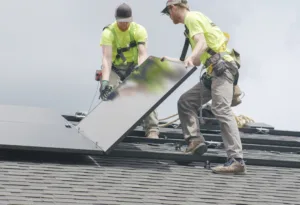
Spokane-based Northwest Renewables electricians install solar electrical systems for both residential and commercial properties.
| Corner Booth Media Inc.Solar and renewable energy system installations on commercial buildings in Spokane have increased since the One Big Beautiful Bill Act was passed in 2025, as building owners and businesses hurry to perform planned projects before a clean energy tax credit ends.
The upcoming elimination of the 30% federal solar Investment Tax Credit for commercial entities is expected to harm the renewable energy business in the commercial sector, contends Gavin Tenold, co-owner of Spokane-based Northwest Renewables LLC. Tenold, however, says he expects the growing need for electricity means the industry will likely continue to grow into the future despite the loss of the tax credit.
Commercial solar projects that began before July 4 this year have until the end of 2030 to be placed in service to receive the tax credit. Projects that missed the July 4 mark have to be completed by the end of 2027 to be eligible for the credit.
The tax credit currently allows businesses to deduct 30% of the system’s purchase and installation cost from their taxes, he says.
“Tax credits have a big impact in what we do, and it could in a way be an indicator of the rush that is happening in the year 2026 here,” says Tenold.
Without the tax incentive, Tenold expects the solar industry in Spokane County to cool.
“We would be foolish not to say that this is going to have an effect on business going forward,” he says.
The One Big Beautiful Bill Act, which was passed July 4, 2025, also eliminated a 30% federal residential clean energy tax credit for individuals installing new solar energy systems on their homes after Dec. 31, 2025.
Other state or utility company incentives and clean energy standards could support the industry, however, and Tenold says he’s optimistic about the renewable energy industry continuing a growth pattern.
Northwest Renewables sells and installs solar panels and batteries, electric vehicle chargers, ductless heating and cooling systems, and other energy-efficiency products for residential and commercial structures, Tenold says. The company is also a full-service electrical and general contractor and doesn’t subcontract that work out.
He describes the company’s current customer base as 70% commercial, 30% residential. The company transitioned from mostly residential solar projects to the commercial building space after 2024, when an influx of out-of-town contractors generated concerns over unethical sales tactics and improper installations overwhelmed the residential solar market here, leading to decreased revenue for Northwest Renewables.
Since focusing on commercial installations, the company has experienced an upward trend in both revenue and the number of projects managed yearly, he says.
Net metering is a solar incentive that keeps companies interested in renewable energy, he says. Customers of power companies with systems generating 100 kilowatts of power or less that are connected to a utility company’s power grid can offset their electricity consumption by producing renewable energy via solar panels.
Customers participating in net metering can receive credits for excess energy generated and can reduce utility bills significantly, Tenold says. Large commercial buildings often instantly consume any renewable power generated by rooftop solar panels and don’t send as much electricity to the grid as residential units with rooftop solar might, he adds.
Along with net metering, Tenold hopes to see more programs by utility companies in Washington that incentivize the use of energy storage systems combined with solar panels, which would be a large draw for commercial customers.
“Looking forward into the future, as we have electric growth and large load customers coming online, we believe that energy storage is going to be a big component, and we look forward to utilities creating programs that incentivize the use of energy storage in parallel with solar so that the electricity is being dispatched to the grid at moments in time when the grid needs it,” he says.
Tenold has seen the need for renewable energy in Spokane County’s commercial sector grow since he and Harlan Heise founded the company in 2016. Northwest Renewables has grown from three employees in 2017 to 27 in 2026. Tenold declines to disclose the company’s exact revenue this year but says it’s trending upward.
Recently, Northwest Renewables worked with Avista Utilities, the operating division of Spokane-based Avista Corp., and other Spokane-area companies including Coffman Engineers Inc., Lydig Construction Inc., and Arc Electric & Lighting Corp. to develop a community-based microgrid system at the Martin Luther King Jr. Family Outreach Center, Tenold says.
The system combines roof- and wall-mounted solar panels, battery storage, and a natural gas backup system to provide the center with power during outages and help reduce the center’s energy costs, he explains.
The system is an example of a creative renewable energy project that organizations want, he contends.
“(That microgrid) is a nice example of some creative installation work, where we actually mounted on a building's wall as well as a roof,” says Tenold.
Currently, Northwest Renewables completes over 100 commercial projects a year — a workload Tenold says he hopes to see continue after the federal tax credit is discontinued.
“I do believe that energy storage and generation in the built environment has a role to play in the future, and the market just needs to figure out how to value these systems,” he says. “Perhaps the commercial tax credit comes back, or it comes back for both commercial and residential. Regardless, I still do believe that the economic case is out there, especially with electric usage growth doing what it’s doing.”

_web.webp?t=1790233399)