
Microgrid installation activates at MLK Center
Combination of solar panels, battery storage, natural gas generator improve resilience
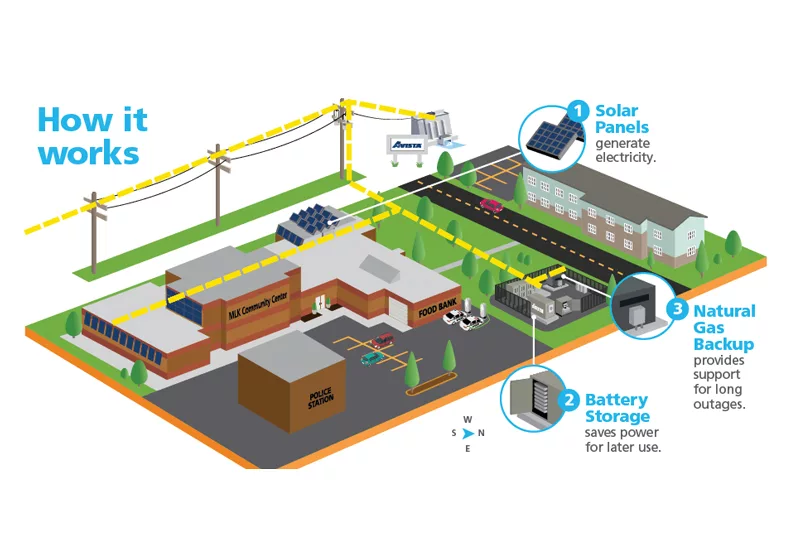
The MLK Resiliency Project operates through a combination of solar panels, battery storage, and a natural gas generator, designed to keep the center open during extended power shortages.
| Avista UtilitiesAvista Utilities, the operating division of Spokane-based Avista Corp., has launched the region’s first community-based microgrid at the Martin Luther King Jr. Family Outreach Center, in Spokane's East Central neighborhood.
The project is designed to inform how energy systems are deployed as power demand grows and extreme weather events become more frequent, says Mike Diedesch, Avista's innovation lab manager.
“I do think we will see more (microgrids),” Diedesch says. “It’s really a tool that can be used in many different ways, and it’s not just about backup power; it’s about providing benefits every day. As we see power systems changing and more demands being placed on them, these tools being distributed throughout can be very helpful.”
The installed microgrid, dubbed the MLK Resiliency Project, is located at 500 S. Stone. The system combines rooftop solar panels, battery storage, and a natural gas backup generator designed to keep the facility operational during extended power shortages. In addition to helping reduce the center’s energy costs, it also serves as a test case for how microgrids can support both community resilience and broader electric grid operations in the future, says Diedesch.
While the prefix “micro” may suggest a small project, the resiliency initiative took three years to develop and implement, Diedesch notes. Avista has long been a partner of the MLK Center, and the idea for the project emerged through conversations between the two organizations. Diedesch credits the center’s executive director, Freda Gandy, for her leadership in driving the project forward, he says.
Avista’s Named Communities Investment Fund contributed $800,000 to the project, and the MLK Center was awarded a $1.5 million grant from the Washington State Department of Commerce. Spokane-area companies involved in the development include Coffman Engineers Inc., Lydig Construction Inc., Northwest Renewables LLC, and Arc Electric & Lighting Corp.
The microgrid consists of 81 rooftop solar panels that are capable of producing enough power to offset about 20% of the center’s annual electricity consumption. In addition, the system includes a 350-kilowatt battery system with the equivalent of about 10 electric vehicles' worth of energy storage and a new 130-kW natural gas generator, he says. The microgrid’s control system is connected to Avista’s control center; so, if the power goes out on the main grid, Avista is able to flip a switch that starts the center’s backup system, energizes the battery system, and allows solar power to come online and serve the center, Diedesch says.
“We’ll be able to operate on solar plus storage for as long as possible,” he says. “Then, for those longer duration outages, once the battery discharges down to a certain level, the natural gas generator will automatically kick on to recharge the battery so that it can continue to serve the center.”
The project also involved installing energy-efficiency improvements inside the building to help extend the solar-plus-storage system, he says. Avista currently is working with the center to identify which systems are most critical and what services must remain online during emergencies.
“We’re here for families every day, and during emergencies, people rely on us even more,” says executive director Gandy in a press release. “This energy system helps us continue that work and keep our doors open for the East Central neighborhood, which means so much to me.”
The project demonstrates how microgrids can provide benefits beyond emergency backup power, Diedesch contends.
“I think of it as a multitool for the power grid,” he says.
In addition to providing energy during outages, microgrids can help utilities improve distribution-system efficiency, increase utilization of existing infrastructure, and offset peak electricity demand, he says.
As energy systems evolve and electricity demand continues to grow, Diedesch says he expects additional microgrids to be deployed throughout Avista’s service territory. As previously reported by the Journal, in Avista’s service area, winter peak demand has increased by more than 12% over the past decade, with summer peaks rising 9%. Globally, demand is expected to grow by more than 3.5% annually.
Each microgrid project also helps establish standards for how these systems are designed, operated, and integrated into utility operations, which could reduce development timelines for future installations, he notes.
“We will continuously improve and try to make the projects easier and quicker to deploy,” Diedesch says.
The MLK Center initiative is the first community-center microgrid funded through Avista’s Named Communities Investment Fund. Avista is seeking additional partnerships with other community organizations interested in pursuing energy resiliency projects, Diedesch says, adding that similar projects will be eligible to apply for support through the program.



_web.webp?t=1790233399)
