SFCC program adapts to meet workforce demand
College responds to growing need for orthotic, prosthetic technicians across the US
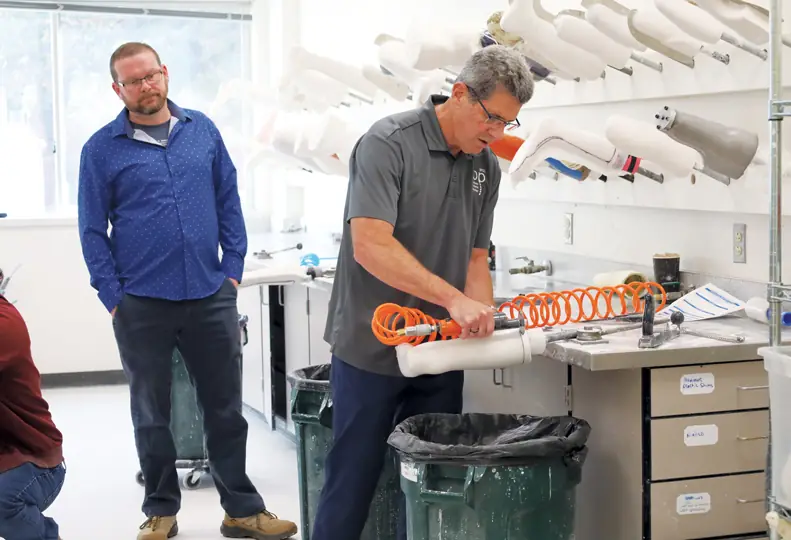
Orthotic and Prosthetic Technology program director Ambrose Cavegn, left, and faculty member Ken Mandler demonstrate fabricating a prosthetic limb to students.
| Ethan PackSpokane Falls Community College’s Orthotic and Prosthetic Technology program — one of only four certified training courses in the nation — has more than tripled its cohort size in three years to help address a nationwide technician shortage.
While still small, this year’s cohort has expanded to 11 students, up from just three students when program director Ambrose Cavegn took steps to restructure the course, he says.
Inside the Technical Arts building on SFCC's campus, students are learning about anatomy, manufacturing, and design across a multiroom lab. Student-designed orthotic braces and prosthetic limbs cover tables in the main room, while unfinished polyurethane legs line the walls of an adjacent studio. Orthotics are external devices that support or align existing limbs, while prosthetics are designed to replace missing ones.
The program’s hands-on training spaces are designed to address a growing industry gap. As clinicians face mounting administrative and insurance requirements, they have less time in the lab, driving up the need for specialized fabricators to build devices.
“There's a shortage of formally trained technicians out in the workforce,” he says.
About three years ago, the college combined orthotic technology and prosthetic technology programs into a single one-year course. The merge reflects the healthcare industry’s shift toward dual certification, as overlapping clinical needs require technicians trained in both disciplines.
“We decided that the one-year program was more beneficial to get students out into the workforce quicker to meet demand,” he says.
Certified by the National Commission on Orthotic and Prosthetic Education, the SFCC program stands alongside only three other certified technician training courses in the country — located in Illinois, Kentucky, and Minnesota.
“It’s hard for the educational portion of our field to keep up with the times, and with all the new technologies, materials, and capabilities that we have, this industry changes really, really fast,” he says. “I see stories on social media where a 16-year-old printed a brain-controlled prosthesis in his bedroom on the weekend, so there's a lot of disruption coming.”
Orthotic and prosthetic technicians design and fabricate braces and artificial limbs while working at hospitals and specialized clinics, Cavegn explains. Students learn how to design and manufacture lower extremity, spinal, and upper extremity devices throughout the course of the program.
“For a very long time in orthotics and prosthetics, clinician education included a heavy amount of fabrication, but about 10 or 15 years ago, the level of clinician education was raised to a master's degree,” Cavegn says. “Since then, those programs have started to focus a lot more on research and paperwork, and because their focus has shifted so much, and clinicians that know how to fabricate are rapidly retiring, there's a void left where newer clinicians don’t have the time to spend in the lab like they did in the past.”
The orthotic and prosthetic technician profession is niche but growing, Cavegn says. SFCC data indicates about 40 people are employed in the field in Spokane County and an estimated 2,500 people are employed in the western United States.
“Any student that graduates this program that wants a job will be able to get one,” he says. “There’s a growing need for formally educated technicians, and I think that the importance of their job and their scope have grown.”
Cavegn and another faculty member Ken Mandler lead the program with assistance from Patience Nicholls, a full-time orthotic and prosthetic instructional technician.
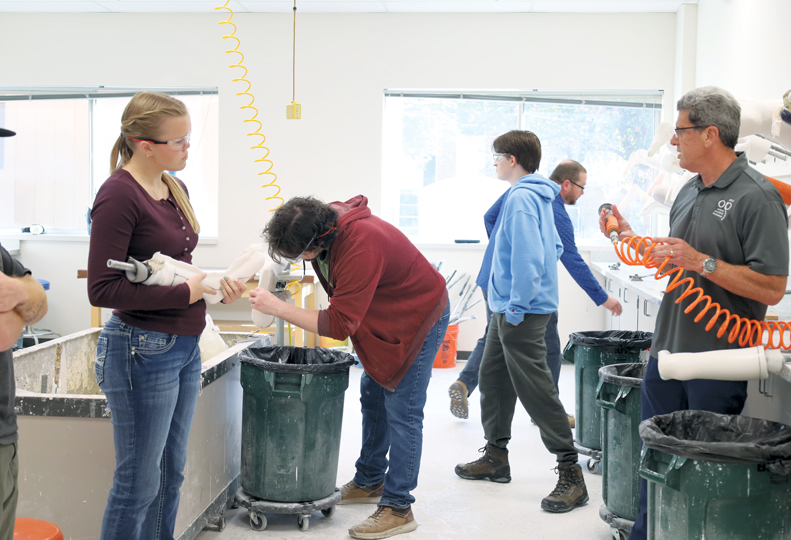 Faculty members Ken Mandler, right, and Ambrose Cavegn teach students how to fabricate artificial limbs in a lab Inside the school's Technical Arts building. -Ethan Pack
Students in the program earn an average of 15 credits per quarter over the course of the academic year. Before completing the program, students must also take a six-credit, 198-hour internship at an orthotic and prosthetic facility, Cavegn says.
To help students get experience in Spokane and find jobs after graduation, Cavegn says he hopes to develop a pipeline between SFCC's program and employers, such as Austin, Texas-based Hanger Prosthetics & Orthotics West Inc., which does business as Hanger Clinic.
The company operates three Spokane-area facilities and owns more than 925 orthotic and prosthetic clinics across the country, according to the company's website.
Currently, there are limited options for hands-on training for students in the program, but a partnership with Hanger Clinic would allow students to develop additional manufacturing and fabrication skills throughout the school year and lead to job opportunities afterwards, Cavegn says.
“You could get your hours at Hanger during the year, and that way, when summer comes, you're just off to work. We haven't had that opportunity in Spokane ever because there are so few clinics here.”
Program graduates earn a certificate of completion in addition to pedorthist certification, for specializing in foot care using support devices, and an orthotic fitter certification, which certifies individuals to adjust, select, and fit custom or off-the-shelf orthotic devices. Students can earn an associate degree in applied science if they choose to complete a second year of additional general education and business classes, says Cavegn.
“There used to be a bigger differentiation between orthotics and prosthetics, where you used to be certified as a prosthetist or orthotist,” says Cavegn. “Now, everyone who graduates from the clinical program is dual certified.”
To enhance the program in the future, Cavegn is working to acquire more digital fabrication and additive manufacturing technologies for the classroom, such as 3D printers, he says.
Traditionally, orthotic and prosthetic technicians use plaster and wraps to cast a patient’s limb. Computer automated manufacturing machines carve required shapes out of polyurethane foam materials, which technicians use to fabricate the device.
New digital tools allow technicians to scan a limb digitally, without the use of expensive and messy plaster, and 3D printers fabricate orthotic and prosthetic devices more quickly and more affordably, Cavegn says.

Stay Informed. It’s Free.
Subscribe to our newsletters and get the latest news and insights delivered to your inbox.
We respect your privacy.
Unsubscribe anytime.
Thank you!
You’re subscribed. Keep an eye on your inbox for the latest updates.