Fulcrum Financial gears up for growth
Travis Messinger is aiming to maintain momentum after founder's July retirement
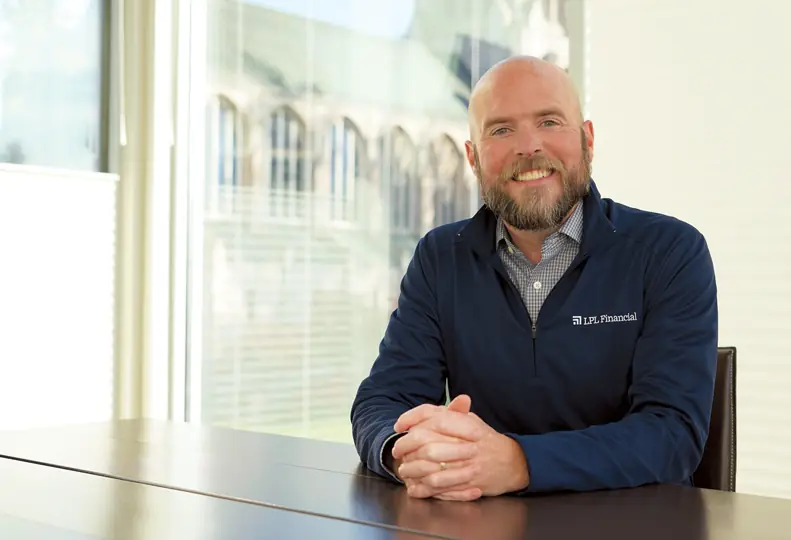
Travis Messinger, a longtime employee at Fulcrum Financial Group, took over leadership of the business in July.
| Matt StephensFueled by a 20% revenue increase and workforce expansion plans, Spokane-based Fulcrum Financial Group LLC is launching its next growth phase under new leadership following the retirement of founder Sarah Carlson.
Travis Messinger, a wealth adviser who has worked at the firm for over a decade, assumed leadership responsibilities following Carlson's retirement in July. The transition comes as the financial advisory group experiences ongoing organic growth and increasing demand for wealth management and retirement planning services.
Messinger leads a four-person full-time team at Fulcrum, with plans to recruit up to two new employees to keep pace with rising demand.
While declining to disclose precise revenue figures, Messinger notes that the firm’s year-to-date revenue has jumped 20% compared to last year. Fulcrum Financial's growth follows several years of steady expansion driven by existing client relationships and marketing efforts through the company's website, social media, and other online platforms.
For Messinger, the goal is balancing rapid expansion with Fulcrum’s long-standing commitment to client-tailored advice.
"We do want to continue to grow," he says. "But we also want to make sure that we have the capacity to provide the best service to not only our current clients, but future clients."
Fulcrum Financial Group's offices are located at 1216 S. Grand Blvd., west of Grand Boulevard and across the street from St. John's Cathedral on Spokane's South Hill. The company provides asset management and comprehensive financial planning services, including retirement planning.
To bridge service gaps, Fulcrum also maintains a network of accounting, legal, and estate planning professionals for its clients. Demand for those services is expected to increase as the region's population ages and older generations transfer accumulated wealth to younger family members.
The generational transfer of assets represents one of the most significant developments shaping the financial advisory industry, Messinger contends.
"It's actually the largest money transfer in history that we're seeing at the moment," he says.
Spokane's population growth and the region's popularity among retirees are creating strong opportunities for wealth advisers here, Messinger says. As the number of retirees grows, the demographic is expected to generate additional demand for strategies addressing retirement income, investment management, and long-term financial stability, he adds.
Market volatility is influencing how individuals approach retirement planning, particularly as investors navigate economic uncertainty and fluctuations in stock and bond markets, he explains. Those conditions have increased the importance of proactive financial planning to ensure retirees can meet their cash flow needs.
Economic uncertainty is also influencing investor behavior, as global events and market conditions prompt some individuals to make decisions out of fear rather than stick to long-term goals, he says. The tendency for emotions and psychological factors to influence investment decisions is a central pillar of behavioral finance.
Despite those pressures, the financial markets are positioned for continued growth through the remainder of 2026 and into 2027, Messinger contends.
"At the beginning of the year, we expected 2026 to be a positive market year at the cost of a lot of volatility," he says.
While elevated stock valuations have raised concerns about market sustainability, high prices aren't an automatic sign of a bubble, Messinger explains — especially when strong corporate earnings and cash flows back them up. Continued business investment and increased spending by companies seeking to remain competitive are also contributing to market strength, he says.
While a market pullback is inevitable, periodic corrections are a natural and healthy part of the investment cycle, he contends.
Adding to those standard cyclical factors is the disruptive rise of new technology. Artificial intelligence has emerged as a major influence on investment activity, contributing to market growth while creating uncertainty about the long-term effects of the technology. The rapid pace of technological development makes it difficult to compare current market conditions with previous periods of innovation, Messinger says.
Investor sentiment around AI remains split, Messinger notes, with some eager to capitalize on its growth potential while others take a more cautious stance.
"I think I see more people excited about the opportunity to make money than they are to be shy of the opportunity," he says.
Looking ahead, the dual forces of rapid technology innovation and the ongoing generational wealth transfer are creating strong tailwinds for advisers helping clients navigate shifting financial priorities.
Overall, the wealth management market remains strong, supported by the movement of inherited assets and continued interest in maintaining investments, Messinger says. He's also anticipating that the current bull market will continue, although unexpected geopolitical or economic developments could quickly alter investor sentiment.
For Fulcrum, the changing financial landscape reinforces the company's emphasis on long-term planning, personalized service, and maintaining close relationships with clients.

Stay Informed. It’s Free.
Subscribe to our newsletters and get the latest news and insights delivered to your inbox.
We respect your privacy.
Unsubscribe anytime.
Thank you!
You’re subscribed. Keep an eye on your inbox for the latest updates.