Water Wise helps Washington Trust plug the drain
Free city program saves $18K annually at bank headquarters
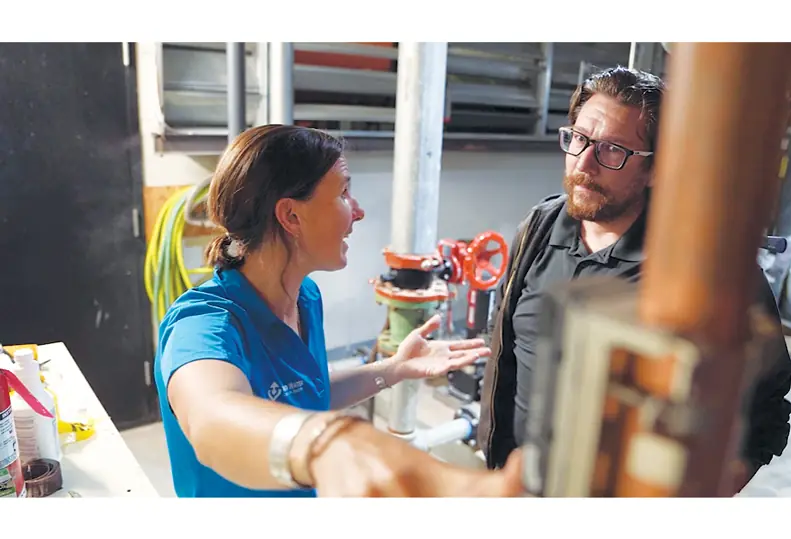
Annikki Chamberlain, of Water Wise, and John DeFord, of K&H Facility Services, audited Washington Trust Bank's water consumption and found ways to save $18,000 and 5 million gallons annually.
| Kiemle HagoodAt Washington Trust Bank's headquarters, the financial institution has saved more than 5 million gallons of water and roughly $18,000 in annual utility costs thanks to a partnership between K&H Facility Services LLC and the city of Spokane’s Water Wise Commercial Efficiency Auditing Program, says Annikki Chamberlain, a commercial water conservation consultant for Water Wise.
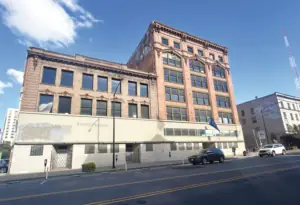
For Chamberlain, the collaboration demonstrates the benefits of combining water-use data with routine building inspections to identify problems that otherwise go unnoticed. Since its launch in 2019, Water Wise has helped guide several commercial buildings towards greater water efficiency. Chamberlain says she hopes the success at the Washington Trust Bank building — known as Washington Trust Bank Tower West, at 717 W. Sprague in downtown Spokane — will inspire other commercial building owners and managers to utilize the city’s free service.
“We’re data-driven,” Chamberlain says. “We’re focused on optimization. We’re going to use actual numbers to help you understand where you are and where you want to get to.”
K&H Facility Services is the comprehensive facility operation and maintenance services division of Spokane-based commercial real estate brokerage Kiemle Hagood. Through Water Wise Spokane, the Commercial Efficiency Auditing Program helps commercial customers reduce water consumption and lower utility costs year-round. The partnership between the two entities began in early 2021, when pandemic-induced lockdowns forced most workers to vacate downtown office buildings and work from home, Chamberlain notes.
Chamberlain’s initial focus was on cooling towers, which are generally used to remove heat from a building’s central cooling system through continuous reuse and circulation of its water.
However, Mike Peck, a class-three facility technician at K&H Facility Services, brought to her attention several single-pass, water-cooled condenser units at Washington Trust Bank Tower West. The condenser units were used to cool small closets containing electrical and telecommunications equipment. Unlike cooling towers, they use water once and then discharge it down the drain, Chamberlain says.
Though the 17-story building was empty, Peck noticed water continuously flowing into a sump pump in the bottom of the building and being discharged during his daily rounds.
“When we’re seeing valves and water flowing all the time, something is wrong,” Peck says. “And this was during COVID; the buildings were empty.”
Chamberlain lent Peck a clamp-on water meter — a tool that grabs onto the outside of a water pipe and measures how much water passes — to help establish how much water was being used.
One of the units was consuming nearly 15,000 gallons of water a day, while two other units were using less than 500 gallons a day, Chamberlain says. Some of the units had aging valves that were not shutting off properly, allowing water to run continuously, even when cooling was unnecessary, she adds.
“It’s a classic problem. Honestly, we see it all over town,” Chamberlain says. “There’s a ton of water-cooled equipment in Spokane. It’s just chronic failures because you can’t stand there all day and see if it’s going to shut off.”
Seeing the accumulated daily data helped diagnose the problem, says John DeFord, a level-three certified building operator at K&H Facility Services.
“You don’t see when it’s unoccupied. Seeing those numbers really helped,” DeFord says.
Following the audit, the single-pass, water-cooled units were replaced with ductless split air conditioning units, eliminating the use of water completely, Peck says. The upgrades eliminated the need for a continuous supply of water to those units, reducing utility costs and the potential for water damage.
Bryan Davis, director of K&H Facility Services, points out that the failure of an AC unit is substantially less catastrophic than a malfunction of a water-based system.
“Water is incredibly difficult to clean up in a building when it’s not where it’s supposed to be,” Davis says.
In Spokane, water has historically been plentiful, cheap, and an efficient way to cool, Chamberlain says. However, as systems change and rates increase, more people will become interested in how to save water and costs.
“We don’t have a scarcity issue; we have an infrastructure issue,” Chamberlain says.
Additionally, mineral buildup, including calcium and hard metals, can damage cooling tower equipment, making it important to balance water conservation with system efficiency, DeFord says.
Since completing this project, K&H Facility Services and Water Wise have expanded their collaboration to other properties, including monitoring cooling towers at Washington Trust Bank Tower East, at 601 W. Riverside. Work also involves the evaluation of water irrigation systems at Riverpoint One Building, at 501 N. Riverpoint Blvd., and at Spokane Colleges properties, Chamberlain says.
The partnership has also helped identify water leaks at two other Washington Trust Bank properties, including a training facility where a single-pass unit was using an estimated four gallons of water per minute.
The city is also transitioning to an advanced metering system that will provide hourly water consumption data rather than monthly readings. The new system allows property owners to more readily identify unusual water use, such as water running continuously overnight in an unoccupied building or gradual increases in consumption that might indicate a developing leak, Chamberlain says.
For commercial property owners interested in participating, Water Wise offers free site assessments, equipment monitoring, and technical assistance to help determine where water use can be improved.
“We don’t judge the system; we just help them optimize as best they can,” Chamberlain says.


Stay Informed. It’s Free.
Subscribe to our newsletters and get the latest news and insights delivered to your inbox.
We respect your privacy.
Unsubscribe anytime.
Thank you!
You’re subscribed. Keep an eye on your inbox for the latest updates.