Five Takeaways: Spokane's Startup Scene
with Fred Brown, Omniscia AI founder
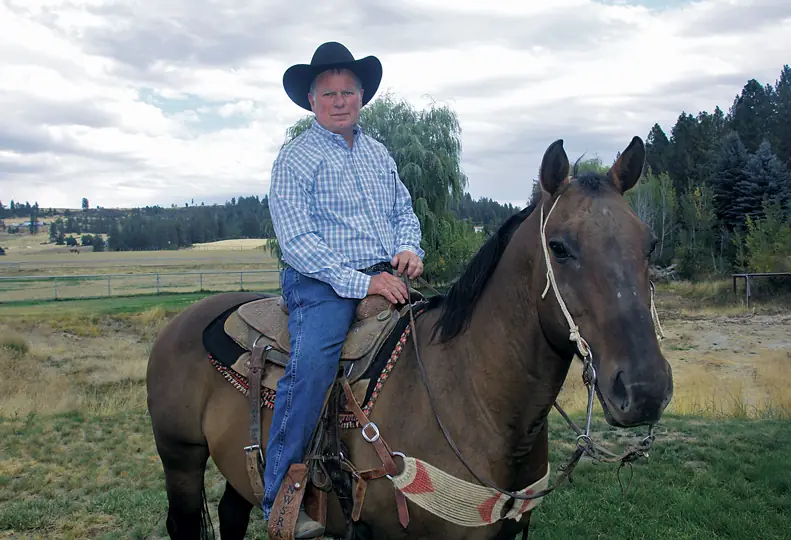
Fred Brown, a serial entrepreneur shown here at his 160-acre ranch near Colbert, is the founder of Omniscia AI.
| Mike McLeanFor its latest episode of Elevating The Conversation, the Journal sat down with Fred Brown, a serial entrepreneur and the founder of Omniscia AI, to discuss Spokane's startup scene.
The Elevating The Conversation podcast is available on Apple Podcasts, Amazon Music, Spotify, and elsewhere. Search for it on any of those platforms or the Journal's website to hear the entire conversation, but for now, here are five takeaways — edited for space and clarity — from the episode.
1. Accessing capital is the greatest challenge for startups.
I always and still believe that capital for startups is the biggest problem.
If you look at what our federal government does, they try to stimulate, but almost half of our economy is small business. We have the small business associations and things like that, but at the end of the day, if you've got a good idea and it's a vetted good idea, how do you get it going? Friends and family, borrowing money, you know, it's a tough road.
It's way, way cheaper for a big company to buy somebody that's made technology than it is to develop it themselves.
People are innovative. It's doing something they love. It's what drives our economy, and I don't think the federal government puts enough money into that.
Where are the dollars for somebody with a good idea?
If I could make one thing happen, it would be make that capital source available. And that's what angel funds and early-stage investors try to do. But what's happening now in our economy, they're looking at it more like a (venture capitalist) used to. A VC's looking at it more like an equity investor, and they're looking at it more like a public investor.
So, the things you have to have done to get capital now, it's just too hard.
2. Startups don’t have to be centered around artificial intelligence, but founders should take advantage of AI if it can help their business.
I believe that any startup has to find a problem. A problem that's out there in a market. You gotta know something about that market, and you gotta figure out how to solve that problem.
Those are the fundamentals that have been there for 100 years. The practicality of solving those problems today is AI can help you do that. If it's technology, it can help you create technology 10 times faster than you could three years ago, maybe even two years ago.
Yes, a sophisticated investor would want to know how you're delivering that in the safest, fastest way, and they will know that AI can help you do those things. But it's not because it's AI. It's because of your idea, their trust in you, their belief that you can do it, your understanding of the market, and your understanding of the problem.
3. More collaboration is needed to increase capital for startups in the Spokane region.
I think we should be, as a community, combining our resources, our political capabilities, our lobbying, and that should be the number one priority: how do we get a pot of money that can be spent in Spokane or in the region?
And how do we help innovation? And we talk to all of the people that care — real estate people, companies that impact that, and get banks, get a fund put together.
Think about how the VC market does it. Some VC writes a check, and then there are loans that can be had with that and it creates capital. That's a good startup model.
I think it's just coordinating that as a group of people with influence and doing it.
There's some new blood in town that's come in that has some expertise. But it's too noisy. There are too many people doing different things.
My dad would say, "You need the exuberance of youth and the wisdom of age."
You team those two up, and you can get success. So, with that problem, that's what I would say too. You need some young people that want to go make a difference driving that train, and you need some old guys like me that know a little bit about it and the school of hard knocks and see what happens.
4. If you have a good idea, pursue it.
“Fire, ready, aim” is a motto I use very much for startups. Everybody’s like, “What the heck are you talking about? That's not what I learned.”
Well, let me explain it.
Fire is taking the step. You can sit around and think about something ‘til it wears out and it's not a good idea anymore. Got a good idea? Try it. That's what fire is.
Ready is see how it works. There are thousands of pivots you gotta make to get a company going. So, you do it, you test it, you figure it out, you pivot it.
Once you get it all figured out, so you're ready, now you aim. If you aim upfront, you're wrong. You're shooting at the wrong thing. That applies to any startup.
5. The Inland Northwest is a good place to launch a startup.
Our resources are wonderful. There's every resource you need to do a startup right here or within a small area.
There are universities that can help you. Those are really cool. There are companies that have programs to help you. There are people here to help you.
Cost of living's pretty good. It's a wonderful place to raise a family. When you're an entrepreneur, you work a lot, so you need a place that your family can feel safe and productive and growing.
I think there's a genuine community interest in startups. We're just not sure how to channel all of that, but there's a lot of energy there. And that's a good thing.


Stay Informed. It’s Free.
Subscribe to our newsletters and get the latest news and insights delivered to your inbox.
We respect your privacy.
Unsubscribe anytime.
Thank you!
You’re subscribed. Keep an eye on your inbox for the latest updates.