Five Takeaways: Spokane's Startup Scene
with Ignite Northwest CEO Tom Simpson
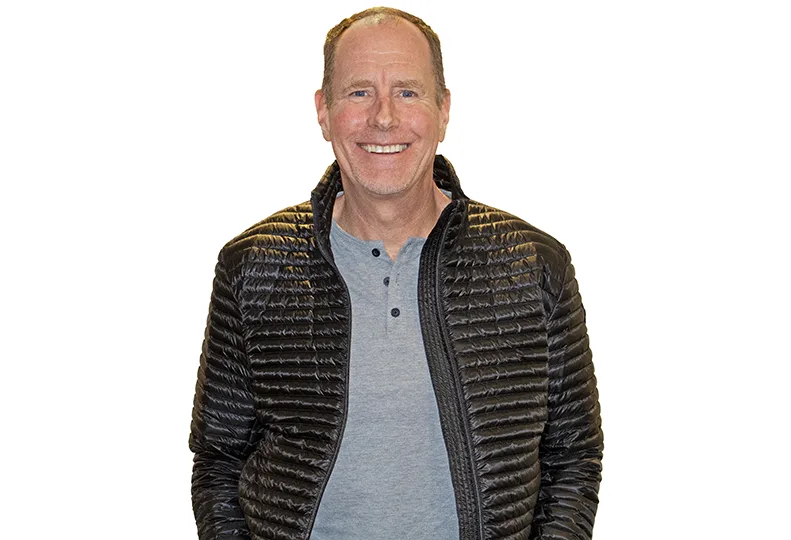
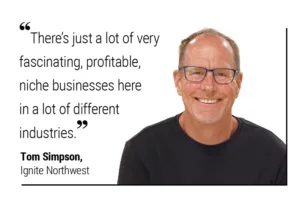
For its latest episode of Elevating The Conversation, the Journal sat down with Tom Simpson, the CEO of Ignite Northwest and president of the Spokane Angel Alliance, to discuss Spokane's startup scene.
The Elevating The Conversation podcast is available on Apple Podcasts, Amazon Music, Spotify, and elsewhere. Search for it on any of those platforms or the Journal's website to hear the entire conversation, but for now, here are five takeaways — edited for space and clarity — from the episode.
1. Spokane’s startup ecosystem continues to improve despite economic uncertainty.
It keeps getting better every year. There's a number of new companies that have come on the landscape this year, new talent in Spokane.
People continue to find this region as an attractive place to start and grow a business and I'm regularly seeing that. You know, a great example that you guys recently covered is Jordan Allen and BuyWander. Jordan started that company a year, year-and-a-half ago, and is doing phenomenally well.
I'm an entrepreneur. We are always optimistic. And there's always uncertainty. There's always variables that you don't know the answers to.
I tend to filter much of that out. And frankly, a lot of very successful entrepreneurs do the same. So regardless of where we are in a cycle and the uncertainties, new companies still get formed and get started. If you look back over time, in many cases, during times of uncertainty or economic conditions that aren't necessarily effervescent, a lot of great companies are started.
So, I don't get too caught up on exactly what's going on in the economic or political cycle because new companies get started all the time. During times of market bubbles, so to speak, I'm actually a bit more cautious. We might be in a bit of a bubble right now with (artificial intelligence).
2. Passionate people, revolutionary ideas, and uncluttered markets make startups more attractive to potential investors.
I want to invest in teams of people that are bubbling over with passion for what they're doing.
When I meet a new team, my first question is, why are you here today? Why are you forming this company? And the answer I want to hear is something that I would imagine I might have heard had I had the chance to interview people like Bill Gates when they formed Microsoft; Howard Schultz, when they started Starbucks; Phil Knight, when they started Nike; Jeff Bezos, when he started Amazon.
All of those people were just filled with passion for what they wanted to start and build. The idea of becoming incredibly rich was not one of them. They had an idea for a company — a shoe company, a coffee company, a software company, an e-commerce company — that was very large.
And that's what I want to see, people that have that vision, but then also a reality check and a plan on how to get there. Not just hope, not just belief, but they've really done their research and they have a plan and an idea on how they're going to get there. They have the tenacity, the grit, the creativity, the charisma to be able to execute. So that's the people category.
In terms of ideas, I want to find something that is revolutionary, not evolutionary. Something that's new and different and bold. One that doesn't have a lot of existing competitors, one that is proprietary in some way. That's the idea.
In terms of the market, markets that appear to be very large in the future, markets that are uncluttered with existing competition, markets for which you can deploy a profitable business model.
So, people, ideas, and markets.
3. The region needs to support startups and new innovation to fill the voids left by companies that leave or reach the end of their life cycles.
All businesses have their business matrixes of their product portfolios. They have the cash cows, the existing businesses or product lines that have been around for years that are generating the largest wealth creation, revenues, employee base.
But the really smart companies are also thinking about the rising stars, the products within their portfolio that at some point in time are going to replace the cash cows. They're going to be the businesses or the products that drive the companies in the future.
And as a region, we need to really pay attention to that life cycle of businesses to ensure that as the PotlatchDeltics do get acquired and maybe move out of Spokane, like other companies have over the years, that we are refueling that life cycle of businesses with new startups and new innovation and make sure that as a community, that we're putting a lot of resources into ensuring that Spokane and our region are building and creating and supporting and funding new businesses.
4. The Spokane region is an ideal place to start or grow a business.
In the current environment of remote work and the tools that we have to enable that, you can choose to start a business wherever you want.
Our region offers the quality of life that is really unparalleled.
Whatever you might like, whether it be skiing or golfing or boating, we have all of the outdoor recreational opportunities here. We have great neighborhoods. We have great schools. We have a great infrastructure of arts and entertainment. We have two medical schools. We have universities.
Spokane's a great place to live.
Obviously, I'm a bit biased. I grew up here. I chose to move back here 25 years ago. But I hear and see it from others that regularly reach out to me from Seattle or San Francisco and others, and they're at the point they're contemplating to move and they want to know about Spokane.
So that is a reason to be here if you're a founder. And then from there, you can recruit from everywhere. Now, you'll find a lot of wonderful employees here in Spokane, but you're never going to find your full team in one city anymore.
So, where you might have holes in your org structure and you can't find local talent, you can hire someone from elsewhere.
The last thing I'm going to say is what I didn't lead with; it's very affordable here.
5. The Inland Northwest has many people and organizations that are working to guide the next generation of companies.
What I would like to see is an alignment in recognition that it's incredibly important within our region that we do prioritize funding of new companies.
That prioritizing innovation, startups, and emerging growth is something that is really important. That all the policy makers, the elected officials, the business community, the universities all agree that innovation and entrepreneurship is a priority for our region, like we've seen in places like Bend, (Oregon), or Boulder, Colorado, — other comparable, highly successful entrepreneurial communities.
The next thing I would like to see is an agreement that we're going to market this region based on quality of life and all the things it has to offer. Lead with that as we recruit businesses or get people to start companies here, rather than go out and say, “Move to Spokane 'cause it's cheap.”
We have a lot of great people that are working on (Spokane’s startup scene). I really want to give credit to people like Bill Kalivas, Michaele Armstrong, what Skye Henderson is doing at Fuel (Coworking), what (Health Sciences & Services Authority) or Spokane County is doing.
All of those entities are working very closely together to support, spawn, mentor, and guide the next generation of emerging companies here in Spokane.