View from a Stratotanker
-
Living in the Spokane area, odds are you’ve probably seen at least one of Fairchild Air Force Base’s big gray refueling tankers pass overhead on one of its daily missions.
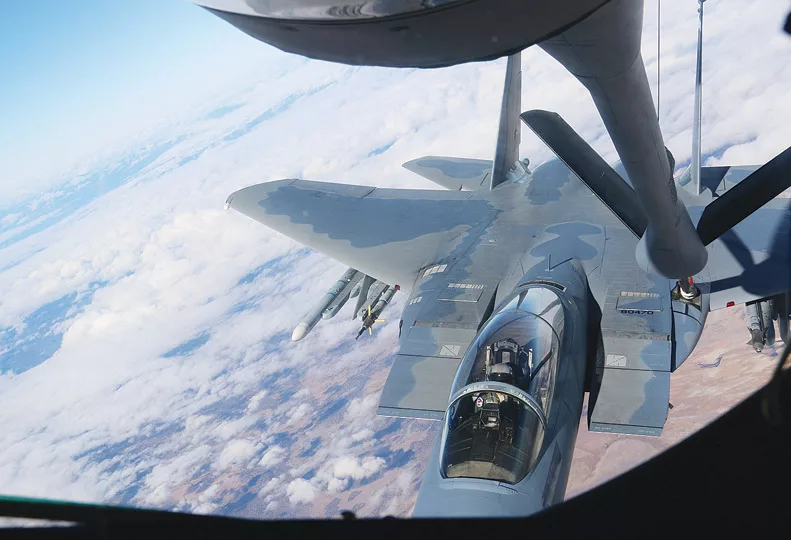
However, the experience of watching as one of those KC-135 Stratotankers refuels an F-15 fighter jet at 28,000 feet, doesn’t feel like a routine one could get used to.
Earlier this month, representatives from the Journal and other local media were invited to ride along on what would be a four-hour, 900-mile flight to witness the refueling process in action.
Fairchild Air Force Base, located just west of Spokane, is home to the 92nd Air Refueling Wing and the 141st Air Refueling Wing Washington Air National Guard. In addition to employing some 5,000 people, it also is the home base for about 30 KC-135 Stratotankers.
Prior to boarding one of those tankers, reporters spoke with Col. Ryan Samuelson, who assumed command of the 92nd Air Refueling Wing in July.
“The Air Force has 34 tanker locations and seven active tanker duty wings,” he says. “The purpose of this flight is largely as a training exercise, but also a mission to refuel area planes so they can complete their own mission exercises.”
In addition to providing aerial refueling support to Air Force, Navy, Marine Corps, and allied nation aircraft around the world, Samuelson says, Stratotankers are responsible for transporting patients during aeromedical evacuations.
He says Fairchild’s crews perform three to seven refueling missions daily, depending on refueling needs.
“Each mission is carefully calculated based on weather, weight, and other factors, so we can be sure not to waste any fuel,” he says.
Each KC-135 Stratotanker is 136 feet in length, with a wingspan of 130 feet, and a height of 41 feet. The aircraft are capable of transferring fuel loads of up to 200,000 pounds and have an estimated value of $39.6 million each.
According to Samuelson, tankers are fueled from four to six hours prior to takeoff and complete an additional two-hour preflight check, with crews checking and rechecking all parts of the plane.
Although the Stratotanker is modeled after the design of a Boeing 707, the inside is considerably more open, with no forward facing rows of seats or insulation from outside noise.
Consequently, during the flight, both reporters and crew found they had to crack jokes about extra leg room and luggage pickup loud enough to be heard over ear protection.
Air Force data lists the KC-135 as being capable of traveling up to 530 miles per hour at 30,000 feet, with a maximum takeoff weight of 322,500 pounds. The Stratotanker has been previously tested at a capacity of seven days in flight and 36 refuelings.
While a typical KC-135 crew consists of three people—a pilot, co-pilot, and boom operator—the recent flight included a bigger team. Members included Lt. Col. Sarah Lynch, Maj. Denique Asion, Lt. Adam Less, Senior Airman Timothy Webber, Senior Airman Christopher Shelton, Sgt. Jason Bailey, Col. Samuelson, and Staff Sgt. Shawna Sims.
Sims is one of 150 boom operators stationed at Fairchild. A boom is the large contraption attached to the back of a KC-135 through which fuel is transferred to other planes.
As a boom operator, she says, her job requires lying in a crawlspace at the back of the plane, watching the sky below through the glass, and operating the boom so it can safely connect to the incoming planes for refueling.
“We provide both verbal and visual cues, directing receiving aircraft to make contact for refueling,” she says.
Sims says receiving aircraft are directed to stay within what’s called a “receiving envelope,” which is the area in which contact with the boom is safe. Moving outside of this envelope can damage the boom or lead to a mid-air collision.
Generally, she says, receiving aircraft are refueled in 10 to 40 minutes, depending on how much fuel they need.
Sims says in order to become certified, boom operators must train for almost a year, and although the base schedules multiple refueling missions each day, operators typically fly only one or two each week.
Sims’ fellow boom operator, Christopher Shelton, says, “It’s generally easier to connect with smaller aircraft like the F-15 fighter jets, as they’re able to make slight corrections. Larger aircraft have a more difficult time moving about and can take a few tries to connect for refueling,” he says.
Shelton says what he likes about the job is that it’s never dull.
“Even though it’s the same type of aircraft each time, you may have a different crew or different weather conditions,” he says. “We’re constantly learning new refueling techniques, and it’s always exciting.”
The flight’s media passengers got to experience some of that excitement firsthand mid-flight. While the Stratotanker’s first two refueling connections with F-15 jets were successful, a third attempt resulted in what Sims called a delayed disconnect.
“Rather than a triggered disconnect, which we are usually able to initiate with a button, the equipment didn’t release,” she says. “Instead the fighter pilot pulled back, forcing a mechanical separation.”
Because the crew couldn’t be sure whether any equipment was damaged in the separation, no more refueling operations could take place. Instead, the KC-135 flew in formation with other aircraft and continuing to perform receiver training for a while, before returning to Fairchild.
After the flight, Samuelson took a moment to answer reporters’ remaining questions alongside another of the KC-135.
“These aircraft have amazing capabilities, and they’re constantly being upgraded and brought into compliance with modern standards,” he says.
Although the KC-135 is an older model, having first been deployed in 1956, Samuelson says the tankers are reliable and unlikely to be replaced anytime soon.
However, as Fairchild and economic development supporters here are well aware, the Air Force has commissioned a new generation of air-refueling tanker, called the KC-46A Pegasus.
Based on Boeing’s 767 jet airliner, the KC-46A is also a multirole refueling tanker, designed as a replacement for the KC-135.
This past summer, Air Force officials announced Fairchild is one of several bases being considered to house the KC-46A. Scott King, a spokesman for Fairchild, says the base should know by the end of this year whether it has been selected to host some of the new KC-46As.
Samuelson says, “Although we are poised to receive KC-46 aircraft, we remain focused on the KC-135 mission. We are well postured to adapt to any new mission we may be asked to undertake.”