A view from 100
Spokane centenarian Corky Houchin shares why family, growth matter most in life
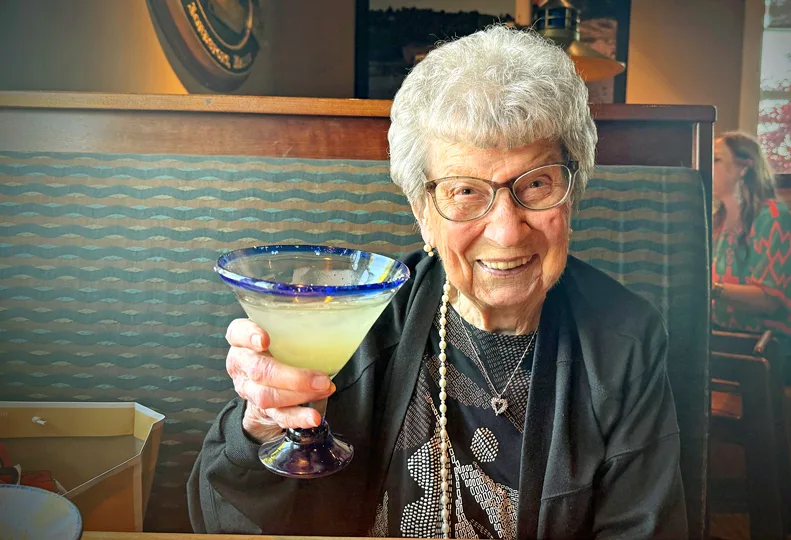
Spokane's Corky Houchin, 100, says family matters most in life.
| Julianne DeanIt seems everyone wants to ask a centenarian the exact same question: What's the secret of living to 100?
Though it’s a fair question, I’m not sure the answer would tell us much. Longevity is a measure of time; it says little about the qualities of life lived between birthdays.
The better question is what’s important after a person has had 100 years to sort through what matters and what doesn't.
Recently, I had the pleasure of talking with Spokane’s Corky Houchin. Born May 1, 1926, Houchin lived in a world that evolved from Model Ts to space shuttles, from switchboard operators to smartphones, and from handwritten letters to artificial intelligence. She lived through the Great Depression, World War II, the assassination of President Kennedy, COVID-19, and technological advancements that shape our lives today.
Yet our conversation had very little to do with historic milestones. It was about people, making choices, and the things that matter most.
When I asked which period of her life had been the happiest, I expected a story from her childhood, her married life, her years raising children, or perhaps her retirement. Instead, she declared without hesitation, “The best time of my whole life was between the ages of 40 and 75,” she said. “Not because those years were easy, but because they were growing years.”
I learned that 40 was the approximate age when Houchin returned to the workforce. At that time, she discovered that the telephone company in Spokane had never hired a 40-year-old woman. In that era, her age and sex were obstacles to getting a job.
Women of her generation grew up with very different expectations. When a great-granddaughter once asked what she had wanted to be when she grew up, Houchin told her she dreamed of becoming the secretary to the President of the United States.
Not the president, mind you, but the president's secretary.
As Houchin explained, “that was about as high as a girl imagined she could go.”
Decades later, she could look at that same little girl in the eyes and tell her something Houchin herself had never heard: “You can be anything you want to be.”
Perhaps that's what Houchin means by growing years. Her life didn't unfold according to a set of goals or a written plan. She adapted as circumstances changed around her.
“When you stop changing, you stop growing,” she told me. “And when you stop growing, you stop living.”
Houchin acknowledged that growth rarely comes without a price, saying: “There’s a payback to everything.”
Like when she returned to the workforce after a divorce, which meant leaving her children at home. Houchin still remembers coming home late one evening when her youngest daughter Julie asked, “Mama, did you work when Jeffy and Stephanie were little?”
“No, I didn’t,” Houchin answered.
Then came the question that still pains her half a century later: “Did you love them more than you love me?”
Even at 100, Houchin's voice broke with emotion.
Houchin went to work because she had to. Her 4-year-old daughter understood only that her mom wasn't there for her.
A century of living doesn't erase those moments, but it does clarify them.
If the middle years taught Houchin how people mature, the last half-century showed her how quickly the world can change.
Given everything she’s witnessed, I asked which advancement transformed her life the most. Houchin believes no invention has changed business, communication, and daily life more dramatically than the computer. Yet her assessment wasn't entirely positive.
“The computer has brought tremendous benefits while also changing people’s relationships in troubling ways,” she said. “It has connected the world while, in some respects, distancing us from one another.”
Technology, however, wasn't where Houchin's thoughts lingered. When I asked what mattered most after a century of living, she never mentioned inventions, careers, or accomplishments. She answered with one word.
“Family.”
A few months ago, Houchin's daughters wanted to throw her a 100th birthday celebration. Houchin wasn't particularly interested in a party. She didn't want gifts or recognition.
“I just want my family here,” she told them.
All 41 came.
Children, grandchildren, and extended family traveled to Spokane to be with her. Two grandsons who routinely phone and announce themselves as "your favorite grandson" even confronted her together, arm-in-arm, and insisted that she settle the matter once and for all. Which one really is her favorite?
Houchin chuckled, telling me the story.
At 100, many of her friends are gone. Her eyesight and hearing aren't what they once were. And she told me something I didn't expect: one of the things she misses most is being needed.
For much of her life, people needed Houchin — to raise children, to work, to volunteer, to help at church, to make a difference. Today, she half-jokes, everyone smiles at her, but nobody asks her to do anything.
That point stuck with me.
We spend much of our lives griping about people wanting something from us. Children need help. Coworkers need assistance. Churches need volunteers. Aging parents need attention. Perhaps we don't appreciate what a privilege it is to be needed until they stop asking.
After she said family mattered most, I asked, what do we spend too much time worrying about?
Again, she didn’t hesitate.
“Money."
Money is necessary, she acknowledged, but “somewhere along the way we've started confusing wealth with worth.” She worries that we judge others by what they earn, envy those who have more, and assume another dollar will deliver happiness.
To which I asked, what have you learned about happiness?
"Happiness is up to you," she said simply. “Not circumstances. Not politics. Not the economy. Not luck. You.”
When I hung up the phone, I thought about our conversation, both what she said and what she chose not to say. Corky didn’t dwell on wars, presidents, inventions, or possessions.
She remembered telling her great-granddaughter she could be anything she wanted.
She remembered her 4-year-old daughter asking whether her mother loved her.
She remembered the feeling of being useful and being needed.
She remembered not wanting gifts, only family.
Though people spend decades pursuing bigger houses, larger bank accounts, impressive work titles, and the latest technologies, when someone has lived long enough to experience an entire century, those material things barely warrant a mention.
What matters are the people who walk beside us.
The family that gathers around us.
The work that makes us useful.
And, the choice to be happy.
Perhaps wisdom isn't more answers. Perhaps it’s learning which questions to ask.
Kevin Spafford, CFP, is a partner adviser with Allworth Financial in Spokane. He is available at the office: (509) 624-5929; by cell: (530) 966-5560; or by email: [email protected].