Inland Power strategically expands underground
Electric co-op to invest about $41M annually to bury power lines
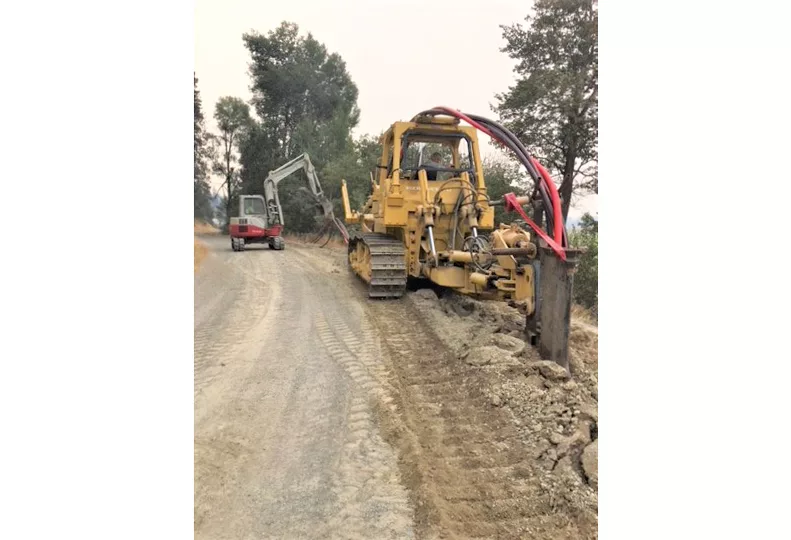
Crews from Inland Power & Light Co. dig a trench for the installation of an underground power line on McCoy Road in Newman Lake.
| Inland Power & Light Co.In response to growing safety concerns and in an effort to improve reliability standards, Spokane-based electric cooperative Inland Power & Light Co. is preparing to expand its underground power distribution system significantly.
The co-op, which serves over 47,000 member-owners across 13 counties in Eastern Washington and North Idaho, currently is developing a 10-year work plan to address needed upgrades to an extensive network that encompasses 7,800 miles of existing overhead power lines, says Andy Barth, vice president of government and community relations at Inland Power & Light Co.
Inland Power & Light is planning to invest an average of $41 million annually on new and existing service work to improve the safety and reliability of its power system.
"Wildfire safety and mitigation is what's driving this," he says. "It also improves reliability from an outage standpoint, that specifically focuses on things coming into contact with overhead lines."
Despite the increased costs associated with the work, environmental concerns, and permitting hurdles, moving power lines underground will offer additional benefits to the utility provider and consumers, he says.
"If it's underground, you're not going to have to worry about branches falling off. You're not going to have to worry about a car-versus-pole situation that happens quite often. And those factors can really help with reliability and safety," says Barth.
Additionally, moving power lines underground will reduce maintenance costs, as crews won't have to monitor and maintain the growth of vegetation around existing overhead lines.
Inland Power's 10-year work plan is expected to significantly ramp up the relocation of existing power lines underground.
"Usually in the past, we've averaged about 10 miles of line upgrades per year. This plan is preparing for 50 miles of upgrades per year. That's not counting any of the new installations, new services. This is strictly just upgrades to the lines," says Barth.
Inland Power automatically installs its new services below ground unless there are unfavorable ground conditions present, such as the presence of basalt, obstructions, or wetlands. Barth notes that compared to new service installation, the conversion of existing overhead line is an ongoing, complex, and long-term process involving working with property owners and collaborating with eight state agencies to ensure environmental stewardship. The process also is significantly more expensive.
"It's anywhere from six to 10 times more expensive to do underground," he says.
The electric co-op is addressing overhead line concerns by prioritizing more high-risk areas, such as in heavily wooded environments, to relocate power lines underground.
One of Inland Power's projects is located about two miles south of Mount Spokane on North Madison Road, where the co-op is planning to relocate about six miles of existing overhead electric line underground and remove 33 utility poles, according to information on file with the Washington state Department of Ecology's State Environmental Policy Act Register.
Half of the new line at the site will follow the route of the existing overhead line and poles, while the remaining half will follow existing access roads, where the line will be plowed in and bored under roads and streams at three locations. Eight junction boxes and five transformers also are planned along the underground route, environmental permit information shows.
Another project in northeast Spokane County will remove a half-mile of existing overhead line on the foothills of Mount Spokane on north Moody Lane. New underground lines will be installed by plowing and boring in addition to small pits that will be excavated for the installation of three junction boxes and a transformer, according to SEPA information.
A third project will relocate another half-mile of above-ground line below grade from Inland Power & Light's Green Bluff substation, at 19414 N. Day Mount Spokane Road. The project will replace power lines that run north along Day Mount Spokane Road, then east along Sillman Road, and north again on Madison Road.
About half of Inland Power & Light's 120 employees are involved in line management and will benefit from enhanced safety and a reduction in dangerous work conditions as more power lines are moved underground, Barth contends.
Underground line upgrades also are expected to benefit a strained power grid that's been operating at capacity due to regional population growth, increased electrification needs, and a complex relationship with renewable energy integration, he says.
Barth explains that the power grid in the Pacific Northwest is "tapped out" and struggling to meet the current demand, let alone an increased demand attributed to consumer products and services that require electricity to function.
The growing demand on the power grid requires the infrastructure to transmit and distribute power to be physically bigger, "and there needs to be more of it as well," says Barth.
"We are really just stepping up our capital improvements overall," he says. "We see Spokane becoming a major hub for growth, for manufacturing, for a lot of different industries, and we just want to make sure that we're doing everything we can to be ready to serve the community that's rapidly growing."


Stay Informed. It’s Free.
Subscribe to our newsletters and get the latest news and insights delivered to your inbox.
We respect your privacy.
Unsubscribe anytime.
Thank you!
You’re subscribed. Keep an eye on your inbox for the latest updates.