Plans for new ice arena put forward in Spokane Valley
Potential hotel, retail spaces envisioned as part of $44M proposal

A new ice sports facility proposed in Spokane Valley would include complementary commercial development to help offset operations costs.
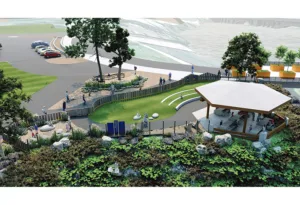
| Garco Construction Inc.In response to surging demand for recreational spaces in Eastern Washington, Innovia Foundation is helping to facilitate a donor-initiated proposal to build a 65,000-square-foot two-sheet ice facility near Spokane Valley Mall.
As envisioned, the project, tentatively dubbed Spokane Valley Ice Facility, would increase capacity for ice sports in the Inland Northwest, where community members have long expressed a need for additional practice and game space, says Innovia CEO Shelly O'Quinn.
Preliminary development plans call for the construction of an indoor arena with two ice sheets where multiple games or practices can occur simultaneously, explains O'Quinn. The expected seating capacity is between 500 and 700.
Additionally, team facilities, locker rooms, skate rentals, and concession areas are proposed, according to planning documents presented to Spokane Valley City Council at a Sept. 30 meeting.
Three properties have so far been evaluated by Spokane-based Garco Construction Inc., which has been selected as the contractor for the design and build of the proposed ice facility, she says. A vacant 11-acre property owned by the city, at 2100 N. Sullivan Road, has emerged as a top contender to host the site due to its central location and access to Interstate 90, she adds.
"We're simply asking for the city to provide the property on a long-term 99-year lease at a significantly reduced price and put in the infrastructure, sewer, and roadway onto the site," says O'Quinn. "Right now, we're working to ... identify next steps to negotiate what a long-term lease on the property would look like."
To help offset the facility's operating costs, the scope of the project also includes the development of a 120-room hotel and other commercial spaces, says O'Quinn, who adds that the final brand and design of the hotel are yet to be determined.
The hotel may also include meeting and event space and other visitor amenities, according to project proposal information. About 4,500 square feet of flexible commercial space also is envisioned for restaurant or retail uses, plans show.
The projected value of the ice facility development is about $44 million, and will be financed by a group of private donors.
"There's one major donor behind this proposal and then several others inspired by their generosity that are joining in," she says. "The (major) donor has a longtime connection with youth hockey and saw there was a need in the community."
The primary driver of the proposal is a lack of existing infrastructure and resources to meet the current demand for ice sports, she says. Existing facilities are described as overscheduled and outdated, athletes are often turned away, and youth programming is hampered by inconsistent and limited ice time or late-night availability, proposal information shows.
If approved, the ice sports facility would be a significant investment in regional tourism that aligns with the city's strategic tourism plan, which identifies additional ice capacity as a top priority for sports tourism and recreation infrastructure, she says.
The proposal received strong support from community members and other organizations during a recent public hearing, which included attendees from the Spokane area, North Idaho, and the Tri-Cities, O'Quinn notes.
The Spokane Americans Youth Hockey Association, which serves 450 children and their families, also showed support for a new ice facility, according to the proposal.
"The (Spokane) Chiefs have identified that this would be their Valley practice location," O'Quinn says. "Those partnerships with the community, with the addition of events, and a partnership with Spokane Sports trickles into economic impact for Valley residents as well as having this amazing amenity in their backyard."
The property is expected to serve as a hub and help attract regional and national tournaments that can elevate the community as an ice sports destination, she says.
The ice facility is projected to generate about $5.6 million in annual visitor spending and about 9,800 new hotel room nights once operational, according to proposal information.
O'Quinn notes that similar projects previously have been considered but lacked the necessary financial resources to move forward. The presentation to city officials mentioned there have been four different proposals to bring a new ice facility to the community. Current plans for a new ice facility have built upon previous research done during previous attempts.
If approved, construction of a new facility could begin spring 2026 and wrap up in about a year.
"Innovia's role as a community foundation is to help connect donor generosity back to the community," says O'Quinn. "And in this case, it is truly donor-directed generosity back to the community, but we are helping that donor make this possible."