Spokane architects share possibilities, concerns about AI
Chatbots, image generators among most-used programs in profession
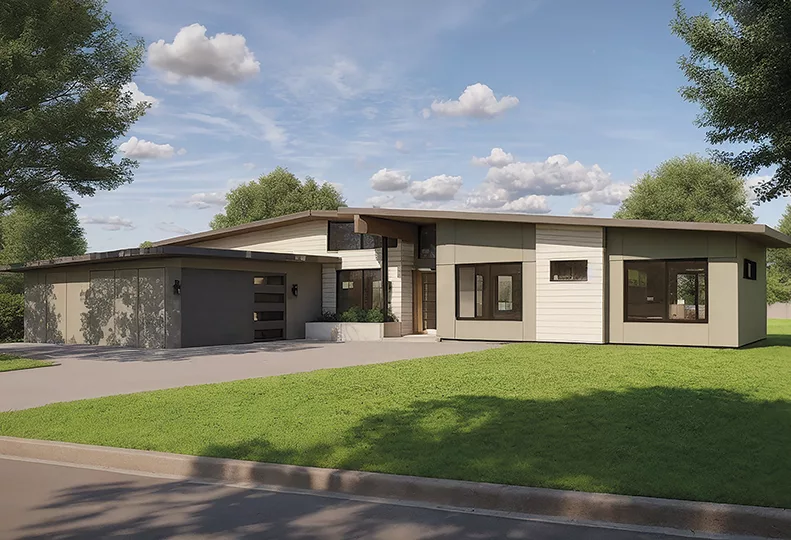
A midcentury concept home rendering includes foliage, sky, light, and shadows added by Chaos Enscape, an AI-powered architectural tool.
| Fusion ArchitectureArchitects in Spokane and across the country have some mixed feelings about the use of artificial intelligence tools in their craft, according to some industry experts here.
According to a study on AI adoption in architecture firms, published earlier this year by the American Institute of Architects, only 6% of architectural professionals regularly use AI for their job. However, more than half of those surveyed have experimented with using AI tools at some point in their practice.
The tools architects choose to try aren’t one-size-fits-all programs that create building plans from scratch, the study says — chatbots like ChatGPT, which are used for research and communicating with clients; image generators like Midjourney, which are used for iterating ideas in the preliminary design stage; and grammar and text analytic software are the most used AI tools. Programs with specific uses in architecture, such as AI-assisted 3D modeling software, sit at the bottom of the most-used list.
About 3 in 4 firms that have adopted or are considering adopting AI tools did so to reduce costs and enhance productivity, the study adds.
Larger firms with more than 50 employees are the most likely to adopt or consider adopting AI, while small firms with fewer than 10 employees are the least likely. And the majority of those surveyed — small, midsized, and large firms alike — have concerns about inaccuracy, unintended consequences, security, authenticity, lack of transparency, regulatory compliance, bias and discrimination, and potential job displacement that may come with AI.
“The thing about architecture is that a huge part of our job is asking questions. And right now, I don't think there's any software that asks you the questions,” says Eric Armstrong, founder and principal architect of Spokane-based Pondera Architecture PC. “I think you can ask it things, and it will surf the internet, scan a bazillion images, and come back and say, ‘OK, this is what your log cabin is going to look like.’ But there's nothing that's out there where you can buy a piece of software that says, ‘Would you like a log cabin?’ And that's all the difference right now.”
Armstrong, the sole employee of Pondera, started his firm in 2008 and hasn’t used AI tools in his practice. He echoes concerns that other architects brought up in the study, namely inaccuracy, regulatory compliance, and the lack of liability.
“If the AI pumps out a nice, beautiful, organic-looking (rendering),” he says, “the architecture team still has to come in and go, ‘How do we build it? Where do the columns go? Does it meet fire code? Does it meet (Americans with Disabilities Act compliance)? Does it actually have the spaces that the client needs to function?’”
However, Armstrong says software like image generators that allow architects to brainstorm how a building might look before designing it could be useful, especially when figuring out what a client wants from a design.
“You can probably type in, ‘I want 50 different images,’ pick the top 10, and show them to the client,” he adds. “So for that reason, I don't think they care about that, knowing that it's just kind of an idea generator.”
Rex Anderson, founder and principal architect of Spokane-based Fusion Architecture PLLC, agrees that AI tools are best used to help architects generate ideas. Fusion Architecture, a firm with seven employees, doesn’t have an official written AI policy but uses some tools, such as PromeAI, a program that turns architectural sketches into renderings through AI; and Chaos Enscape, a plug-in for digital design software, that uses AI to add background details like grass and weather conditions to architect-created visualizations for clients.
“I think that when it comes to the ways that we incorporate AI, it's really in the software programs that we use,” Anderson says. “We incorporate the aspects that those allow with AI, and have employees that are skilled in incorporating that to really help the visualization of the projects.”
Employees at Fusion Architecture also use ChatGPT for research, which can save time learning about architectural trends, he adds.
Fusion Architecture has used Enscape to add background details to two concept renderings in its portfolio — a Scandinavian home concept and a midcentury home concept. But Anderson emphasizes that the buildings themselves and the final products delivered to clients are created by a human architect, with AI tools to help get designs from concept to reality.
“I don't want to see the process lost,” Anderson says. “I think that the human element to architecture is just our ability to design and to kind of listen and interpret and then produce something.”
Large firms, which are most likely to experiment with or use AI, say they’ve found large language models that can both answer questions and generate images to be the most helpful, according to the AIA study.
Dana Harbaugh, CEO of Spokane-based NAC Inc., which has over 200 full-time employees in six offices in the U.S. and Shanghai, China, says his firm recently rolled out the use of Midjourney and another generative AI tool, ComfyUI, to its leadership and is encouraging leaders to use it.
Both Midjourney and ComfyUI can generate multiple pictures from the same prompt, which can save architects the time needed to search similar pictures for inspiration on the internet, Harbaugh says.
“And from that, we might say, ‘These five are pretty interesting. Let's take these five and let's explore those further,’” Harbaugh adds.
NAC’s brief internal AI policy states that while AI-generated content can be used for design iteration, the content is not to be used as the result or deliverable, Harbaugh says.
Spokane-based Integrus Architecture PS, a large firm with about 150 employees split between Portland, Seattle, and Spokane offices, uses AI tools like chatbots and image generators and have been slowly exploring their use, says Tom Robbins, principal and president of Integrus.
While tools like Microsoft Copilot and ChatGPT are used for materials research or preliminary renderings, the company’s internal policy dictates that clients’ information should be used by the tools sparingly.
“Each of our clients bring something to the table, and we need to be respectful of their information,” he says. “Whether we have a formal (nondisclosure agreement) client or just the university down the road, we're stewards of their information. That final design generation, we are not currently using that and presenting that to the client.”
AI has a place in architecture as long as it allows architects to be authentic and meet clients' needs, says Anderson.
“There are aspects to AI where (we ask), how do we just support or build upon what’s already there, make workflow easier for employees, to really take the heavy lifting,” Anderson says, “so we can come up with ideas and stuff like that. That’s the fun stuff.”