
Spokane homebuilders face increased development costs
Updated charges support utilities infrastructure, encourage middle housing
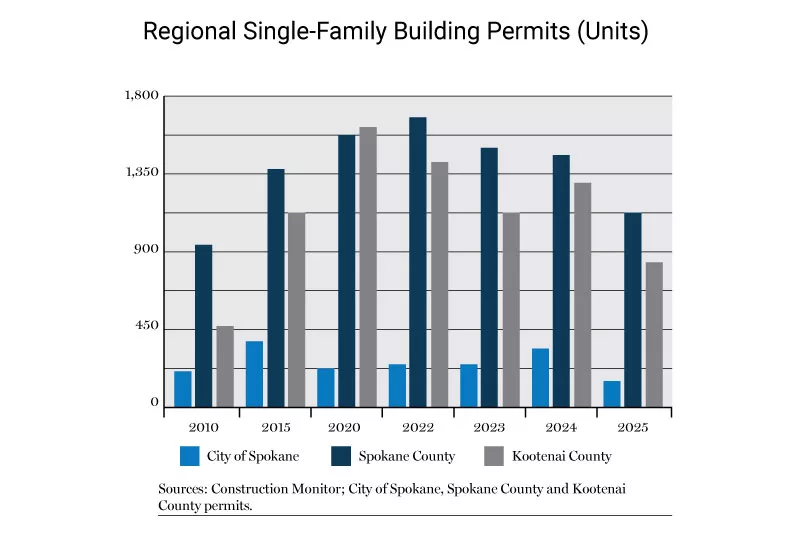
The city of Spokane issued 326 single-family home permits in 2024, an increase from previous years.
Some homebuilders and developers here have expressed frustration with increased costs of permit fees and general facilities charges related to residential building permits in the city of Spokane.
Builders here are contending with increased general facilities charges that were first updated in 2023 after not having been updated for more than 20 years. The charges steadily have increased each year to fund infrastructure and capital improvements for new developments, says Marlene Feist, city of Spokane public works director.
The final general facilities charges increase will go into effect in 2026, Feist adds.
General facilities charges are one-time fees the city’s Public Works & Utilities department charges builders when a new development connects to existing water and sewage systems. Updated fees for the smallest size of water meter, which is five-eights of an inch in size, will increase from $1,683 to $3,366 in 2026, according to the city of Spokane’s website. A 1-inch water meter will increase from $5,266 to $8,415 and a 2-inch meter will increase from $16,458 to $26,930.
“The goal here is to allow those systems to be in good financial health, and so that growth has to pay for part of its share of the issues,” Feist says. “Otherwise, everybody's individual monthly bills would go up to pay for growth.”
Feist says the new prices and meter options provide builders with options to reduce both water usage and the cost to develop new projects and renovations. These fees are charged per lot, not per unit on each lot, and are a flat fee rather than charged based on actual water usage.
“One-inch (meters) have become really popular, but we found that if people were being more conservative with their water use, a three-quarter was more than sufficient,” she says. “And so those kinds of things are options for builders as they consider what's the most effective way to serve their systems.”
Building permit fees also have increased since January, after the city of Spokane’s Development Services Center contracted Redmond, Washington-based Financial Consulting Solutions Group Inc., which does business as FCS Group, to conduct a cost-of-service study for permit services related to building, planning, and engineering functions, according to FCS’s report published in October 2024.
Based on the report’s findings, the Development Services Center increased trade permit fees by roughly 10% in order to better recover costs, says Tami Palmquist, director of the city’s Development Services Center.
“We hadn't raised our rates since 2008 and so we looked across the board at all of our permit fees, and when it came down to it, we did about a 10% increase because we did want to keep things reasonable and make sure that we were appropriately setting fees and that we were in line with the communities around us,” Palmquist says. “But also that we were still making sure that we were covering our costs.”
The majority of the city’s building permit fees are set by the International Code Council’s valuation tables and not locally, Palmquist adds.
Todd Sullivan, managing partner at Hayden, Idaho-based Sullivan Homes PNW LLC, says that the increased costs have made the city of Spokane a difficult place to build new single-family homes. After comparing similar single-family homes Sullivan Homes built in Spokane in 2005 and 2025, he contends that while construction costs when adjusted for inflation have decreased, the permitting and general facilities charges fees have increased 185% due to city and state increases.
“The price we paid for (general facilities charges) and permits in 2005 was $9,163. We are now paying in the city of Spokane with GFCs for water, for sewer, impact fees, technology fees, everything else — we're paying $26,151,” Sullivan says about the difference in cost between the two homes.
Jim Frank, founder of Liberty Lake-based Greenstone Corp., agrees that the current cost of general facility charges has made it difficult for smaller homes to be built by smaller developers.
“If you're doing a fourplex or a sixplex, the city might require that you have a 2-inch water meter. A 2-inch water meter can serve 40 units, but you only have six, but you're being charged for the maximum capacity of the water meter,” Frank says. “What gets punished isn't the big houses. What gets punished is the small units.”
Despite complaints, the city of Spokane has seen record numbers of residential permits filed in the past five years, according to Palmquist.
“We've been over 1,000 new units every year — it's closer to 1,400 — and we're on target to hit that number again,” Palmquist says. “So we haven't been decreasing.”
Spokane was one of the first cities in the state of Washington to enact initiatives rezoning neighborhoods to allow infill housing, or smaller multifamily units on single lots that can provide additional housing options, through the Building Opportunity & Choices for All interim zoning pilot project, says Feist. This middle housing was historically missing in Spokane.
The initiative allows duplexes, triplexes, fourplexes, and other middle-housing developments to be built on nearly all residential lots in Spokane.
“What you're seeing is the ability for us to have some more affordable types (of housing)," she says. “Whether it's fourplex or sixplex units, these kinds of things that really can make home ownership more affordable for more people.”
A record 1,035 multifamily units were permitted in 2024, according to the Development Services Center End of Year & December 2024 Permit Reports. But Frank says costs combined with the length of the permit approval process makes even middle-housing projects difficult for developers.
“(Small residential projects) aren’t being treated as small residential projects. They're being treated as commercial projects, and (the city) is sending that small building or the small fourplex through the same process that you would have to go through if you're building a 10,000-square-foot office building,” Frank says. “It’s unnecessarily complicated, and that's suppressing the ability to build houses because most small developers can't do it.”
In 2024, 326 single-family building permits were issued, according to permit data from the city of Spokane. During the same time, Spokane County issued 1,520 single-family permits and Kootenai County issued 1,278 permits for single-family homes.
The city of Spokane is a smaller geographical area than Spokane or Kootenai counties and therefore sees less single-family permits applied for, Palmquist adds.
Between 2020 and 2023, the city of Spokane experienced an 11% increase in single-family homes permitted compared to the prior four-year average, according the the Development Services Center End of Year reports.
Frank contends the permit process should be simplified to encourage smaller middle housing developments and single-family home projects.
“You can permit something, but that doesn't mean it's going to happen. You have to encourage that use, not just permit that use,” he says. “And encouraging it means making it easy to happen, making the regulatory process around it simple and easy for people.”