Roadmap to Success
$16B in investments for roads, bridges, technology expected by 2050
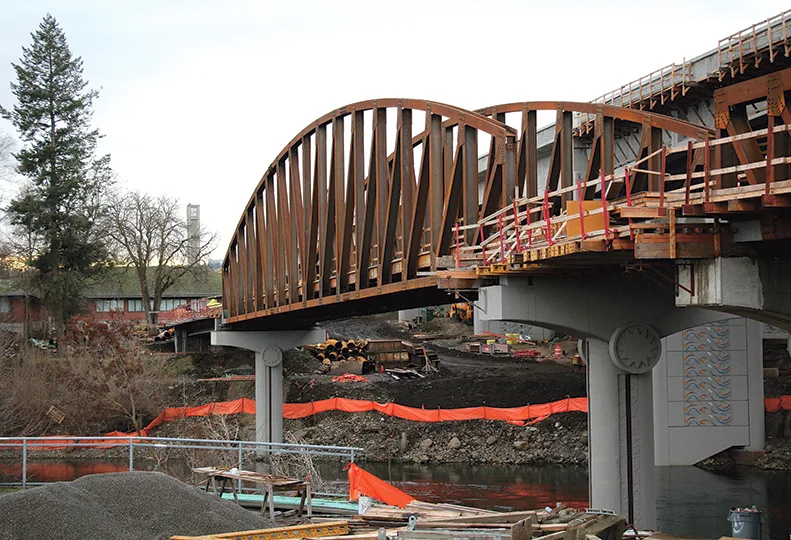
Construction on a section of the North Spokane Corridor — from the Spokane River to Interstate 90 — is a regionally significant project included in Horizon 2050, costing about $633 million in 2026.
| Ethan PackPreservation of existing transportation systems, implementation of new technology, capital improvements, and safety are the focuses of more than $16 billion in investments planned over the next 20 years as part of the Spokane Regional Transportation Council’s newest long-range transportation plan.
Horizon 2050, approved by the council’s board of directors December outlines transportation challenges, needs, and spending priorities in Spokane County, according to the council’s website. A new long-term plan is released every four to five years, with Horizon 2050 including updated information from the previous plan, Horizon 2045, which was approved in 2021.
The Horizon 2050 plan consists of statistics, shortfalls, and improvement planning for all modes of transportation in Spokane County, including freight, transit, active transportation like bicycles, air, and rail systems. The plan also includes updated demographic and population projections and revenue and budget forecasts.
“In a nutshell, it's a blueprint for how we move forward as a region, and where we invest in transportation and how we address some of our deficiencies,” says Jason Lien, principal transportation planner with the Spokane Regional Transportation Council.
The council forecasts both the region’s total transportation revenue and its expenditures between 2026 and 2050 at $16.1 billion, according to the transportation plan. Maintenance and standard operating expenses are estimated to cost $7.4 billion of the estimated revenue, preservation of current infrastructure, such as bridges may take around $4.6 billion, and programs like public transportation and regionally significant capital projects such as the construction of the North Spokane Corridor are expected to cost $2.1 billion each.
Local and regional revenue sources are expected to generate about $5.3 billion, about $4 billion will come from the Washington State Department of Transportation, and $6.9 billion will come from the Spokane Transit Authority, according to Horizon 2050. The funds are public and their use is determined by Horizon 2050 including the needs of Spokane County’s communities, Lien explains.
Preservation and maintenance of the region’s aging transportation network, including 21 bridges that are in poor condition, is the main priority of the plan, he adds.
“We have a lot of assets that are getting older, as they were built some time ago, and making sure that we're properly taking care of the surface condition of pavement and also bridges, and recognizing that we want to keep our existing system and in a state of good repair … is one of the biggest challenges for our region,” Lien says. “To go along with that, as you can imagine, there's some funding challenges — to figure out how to best navigate that, to maintain our existing system and still recognize the need for some capital improvements.”
The region’s infrastructure is facing an increasing backlog of maintenance requests, Lien says. Infrastructure health in Spokane County is considered fair, Lien notes — though the amount of public funding needed to both pay for the maintenance backlog and ongoing preservation projects through 2050 is projected to be short several billion dollars from what is needed.
Washington state’s gas tax of $0.55 per gallon brought in about $3.2 billion, or one-third of the state’s total transportation revenues, in the 2023-2025 biennium, according to data from the Washington State Economic and Revenue Forecast Council. Gas tax revenues have been declining since a peak in 2018, in part due to reduced fuel consumption in the state attributed to a greater adoption of electric vehicles and general improvements in fuel economies, Lien says.
Horizon 2050’s high-level revenue estimate for maintenance and operations upkeep in Spokane County through 2050 is $9.9 billion, surpassing a revenue forecast of $7.4 billion, for a shortfall of $2.5 billion, Lien says. The high-level estimate for preservation is $12.4 billion, outpacing projected revenue of $4.6 billion, for a shortfall of $7.8 billion through 2050.
“I think what would be the most beneficial to the Spokane region and certainly to the state of Washington would be getting a grip on the maintenance and preservation of the system,” says Lois Bollenback, executive director of the Spokane Regional Transportation Council. “If we put off maintenance and preservation — not that we’re putting it off, because we don’t have the revenue to pay for (those costs) if we don’t fund them adequately — we are paying more and it’s costing the taxpayers of the state money by not being able to address the system in the most effective way possible.”
To meet funding demands through the next 25 years, Spokane Regional Transportation Council will be conducting a funding study this year to explore revenue generation options, Bollenback says. Combined state and federal gas taxes constitute the most significant revenue generator the council has, and the study will determine how best to supplement the tax with other revenue sources, such as a road usage tax.
The council will also look at ways to leverage technology to improve the transportation system’s efficiency and improve safety — two outcomes that reduce regional costs, Bollenback adds.
“Years back, (if a road was) getting congested, you’d add another lane, but then you end up with cities with eight-lane roads running through the middle of them,” she says. “Now instead of having to add capacity, which is expensive, we can add technology and move vehicles more safely and efficiently through the existing system, which has a lower price point.”
Bollenback cites Bainbridge Island, Washington-based ZEV co-op, a nonprofit electric vehicle carshare cooperative operating a facility at 521 E. Sharp in Spokane, as one example of technology that could cut emissions, congestion, and infrastructure maintenance costs.
“The opportunity to go to a more vehicle-shared economy, I think, will be tremendous,” she says. “The most amazing thing between now and 2050 is going to be the continued deployment of technology to make our system more efficient to change the way transportation is operated and maintained.”
Spokane Regional Transportation Council is a federally-mandated metropolitan planning organization that oversees transportation planning in the county, according to the council’s website. The council prioritizes projects in the region based on available funding and works to obtain additional funding from local, state, and federal sources.