Advance care planning provides agency, helps families
Rockwood South Hill group recommends Five Wishes directive
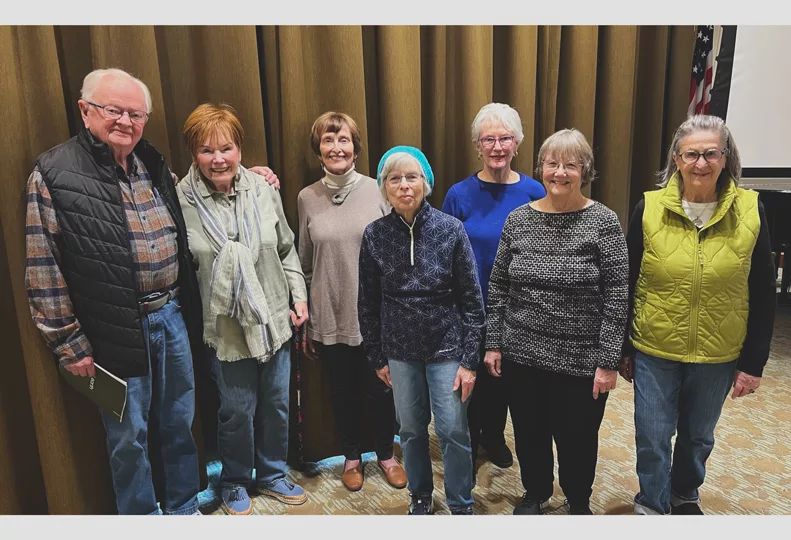
Gil Smith, Christi Smith, Patty Conaty, Judy Hamel, Ann Quinn, Linda Moulder, and Marion Hammer.
| Samantha PeoneMost individuals in the U.S. would prefer to pass away at home surrounded by their family, data shows, yet many die in hospitals, says Rockwood South Hill resident Linda Moulder in a presentation for the Transitions Planning Group.
Moulder co-founded the Transitions Planning Group, which is made up of residents at Spokane-based Rockwood South Hill who discuss end-of-life decision making. Founded in 2014, the resident-led group has hosted Ted Talks showings, panel discussions, workshops, and other related events within the retirement community.
In January, Moulder presented on end-of-life planning, focusing on advance directives.
An important facet of end-of-life planning is completing advance directives, which Moulder says can be broken into three main parts.
The first part is the Portable Orders for Life-Sustaining Treatment form, commonly known as a POLST form, which can represent a person's wishes for future care as clear and specific medical orders, according to the Washington State Medical Association website.
POLST forms are typically bright green in Washington state, and many people hang them on their fridge for ease of access for caretakers or first responders to see, Moulder says. A POLST form must be signed by the patient and their physician, nurse practitioner, or physician assistant-certified in order for it to be legally effective, according to the Washington State Medical Association.
The second main part of completing advance directives is creating a living will, explains Moulder in the presentation. A living will is also referred to as a health care directive, according to nonprofit End of Life Washington.
A living will is a legal statement to all of a person's health care providers that describes their general wishes or desires for end-of-life care, according to End of Life Washington. In particular, living wills speak to whether and how a person wants to be kept alive by medical treatment if they are unable to make decisions.
The third aspect, Moulder says, of preparing advance directives is designating a durable power of attorney.
A durable power of attorney is someone with legal authority to speak on a person's behalf, including after they've become incapacitated. End of Life Washington's website says a durable power of attorney for health care is limited to health care decisions and does not affect a power of attorney for financial or other matters.
Moulder says it’s pretty common for someone to pick their spouse, but that they might not be the best person to choose. For example, a person's spouse may be too emotional about a situation to follow their wishes, or perhaps they are experiencing cognitive decline, she says.
Choosing a child, particularly the eldest, is also a common choice for durable power of attorney, says Moulder. However, a durable power of attorney doesn’t need to be a family member; they can be a friend, minister, or other relation, she says.
If an individual’s chosen durable power of attorney lives far away, it’s good to choose someone nearby who can reach out to the designated durable power of attorney, Moulder says.
“I think if your power of attorney is distant, you’re going to want to have a local person who can interface between you, your doctor, and your power of attorney,” she says.
Rockwood's Transitions Planning Group recommends the Five Wishes advance directive form, a comprehensive advance care planning resource.
The Five Wishes document allows individuals to choose who will make care decisions for them when they are unable to, the kind of treatment they want, how comfortable they want to be, how they want people to treat them, and what they want their loved ones to know.
Moulder says people should place end-of-life documents somewhere that those closest to them knows about. It’s also important for people to visit with their doctors about end of life planning, she says.
According to a flyer for the Transitions Planning Group, copies of end-of-life documents should be given to doctors, health care agents, and the retirement community that a person resides at.
The last portion of the presentation featured a showing of a Ted Talk by Ellen Goodman, a journalist and co-founder of The Conversation Project, an initiative of the Institute for Healthcare Improvement that helps people start conversations with their loved ones about their end-of-life wishes.
“Many of the people we love are not dying in the way that they would choose, and many survivors are left depressed, guilty, and uncertain about whether they have done the right thing,” says Goodman in the Ted Talk. “But we can change that.”
Rockwood South Hill’s Transitions Planning Group was founded in fall 2014, after Mark Hammer, who died last year, read and raved about the book "Being Mortal: Medicine and What Matters in the End" by Atul Gawande, says Moulder. The book addresses issues such as hospice, end-of-life care, and how modern medicine has tended to focus on prolonging life rather than on its quality.
In addition to the various presentations and events, the resident-led group received a small grant to provide end-of-life-related books for the community’s library, Moulder says.
“The fact of the matter is, death is part of the life cycle. It’s not a disease to be cured,” says Moulder.