

Organ recoveries have banner year
New technology, bigger workforce, awareness campaigns contribute to record-high of Washington donations
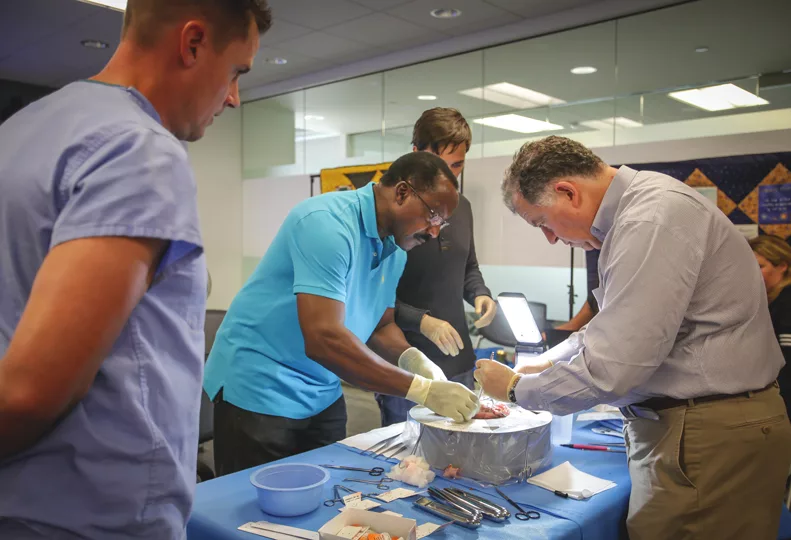
LifeCenter Northwest's organ recovery teams are based in western Washington and travel to hospitals within the nonprofit's service area.
| LifeCenter NorthwestLifeCenter Northwest is capitalizing on a year of high performance following a record number of organs donated in Washington state and organs transplanted nationally in 2025.
The Bellevue, Washington-based organ procurement nonprofit, which has a Spokane office, has recovered 1,013 organs — a 24% increase from 2024 — from 337 Washington state organ donors last year, says Kevin Peterson, vice president of finance and accounting at LifeCenter Northwest. More than 930 patients waiting for an organ donation nationally received transplants from Washington donors.
Despite a decrease of potential donors in 2025, the number of successfully recovered organs increased. Total organ donations were a result of new technologies such as advanced training programs, collaboration with hospital transplant programs, and a growing workforce, rather than an uptick in accidents or deaths, Peterson notes.
A single donor can potentially save the lives of up to eight people by providing organs including the heart, lungs, kidneys, and soft tissues, he says.
“Over the last couple of years, we've developed a virtual reality simulation program,” Peterson explains. “Many of our clinical staff have (access to a) virtual reality training that's essentially an intensive care unit environment in virtual reality, where they can actually interact with others and with a potential donor and learn and grow their skills that way.”
LifeCenter maintains a Spokane office and medical support staff on the fourth floor of a medical office building at 110 W. Cliff Drive, located less than two blocks south of Providence Sacred Heart Medical Center. The nonprofit moved into the space in 2025, Peterson says.
Sacred Heart Medical Center is the second-highest organ recovery hospital in LifeCenter’s coverage area due to its status as the primary emergency trauma center in Eastern Washington, Peterson says, adding that Harborview Medical Center, in Seattle, is LifeCenter's top organ recovery hospital.
Organ recovery specialists and other medical staff that recover donated organs when they become available are based in western Washington and travel within LifeCenter’s more than 800,000-square-mile service area, which includes Washington, Alaska, Montana, and northern Idaho. Washington state has a significantly higher population compared to other states covered by LifeCenter, and typically provides the highest number of organ donors.
The nonprofit has 60 employees in Eastern Washington, more than 250 employees in Washington state, and a nationwide workforce of over 300, he says.
Upon retrieval of a donated organ, LifeCenter facilitates the transport of recovered organs to transplant programs at hospitals nationwide.
“We do the actual organ recovery, but the process starts even before that, meaning interacting with the donor family and working even prior to that with hospitals and maintaining those relationships,” Peterson says. “(We do) everything from recovery to transporting organs or coordinating with a transplant program; sometimes they send their own team to come and get the organ and bring it back.”
Other responsibilities include an aftercare program for both donor families and recipients, and educational efforts such as high school presentations and Division of Motor Vehicles-based outreach and training, he says.
With a 2026 budget of $100 million-plus, LifeCenter provides supplementary programs and covers transport costs and other bills to support clients, says Peterson. The nonprofit’s primary source of funding comes from standard acquisition charges, which are charges the U.S. government requires organ recovery organizations to set for each organ based on what the costs of recovery will be.
“Those standard acquisition charges are paid by the transplant program to which we provide the organ for transplant, so we don't deal individually with recipients,” he says. “For providing tissue like skin or musculoskeletal tissue, we're providing it to a tissue processor who then prepares that tissue for later medical use, and they're paying a standard acquisition charge for each type of tissue that we procure.”
The standard acquisition charge per organ typically ranges between $70,000 to $90,000, he adds. Kidney recovery costs specifically are reimbursed by Medicare and requires LifeCenter to file a yearly cost report to justify the cost of recovery for kidneys for that year.
“If we've collected more in acquisition charges than our cost has been, we have to refund that difference to Medicare. Likewise, if the acquisition charge hasn't covered our kidney recovery cost, they would reimburse us the additional amount as well.”
Kidney donations make up around half of the nonprofit’s overall organ recovery volume, he adds, and Medicare ensuring reimbursement of kidney recovery operations lowers the nonprofit’s financial risk. Kidney transplants are in high demand due to the prevalence of kidney disease.
However, medical costs continue to rise and acquisition charges need to be controlled, he adds.
“We want to be cognizant of how we control our costs, to ensure that we're not unduly causing the cost of a transplant to get to the point that people can't afford to have that,” Peterson explains. “Knowing that medical costs have been a high inflation area, we want to do our part to ensure that we're a good partner with the medical providers we work with, but also seek to make transplants (we provide) attainable to everyone who needs one.”
Transplant costs are usually paid for by insurance, transplant programs, or recipients themselves, he adds.
“We look at (the cost per recovery procedure) based on the per-organ cost, because it is so variable. A given donor could be a single organ donor, or they could be an eight-organ donor,” Peterson says. “That's how the government requires us to set up the cost recovery charges, using those standard acquisition charges that we charge to the transplant program. They require us to have one average rate for every organ, and that's the cost we're trying to manage.”
LifeCenter’s budget has grown recently due to the increased number of organs donated and subsequent increase in standard acquisition charges paid by transplant programs, Peterson says. The charges are also set to enable LifeCenter to grow and hire more employees, but the nonprofit’s expenditure and recovered costs usually break even at the end of the year.
“We set those acquisition charges with the goal in mind that we need to be able to continue to (grow), because the need for organs isn't going away. As of February, there were a little over 1,600 Washingtonians waiting for a transplant,” Peterson says. “So that resonates with our staff, that they have a part to play in making that organ available.”




_web.webp?t=1790233399)
