ZBA stays busy due to housing, shelter needs
Architecture firm's clients include nonprofits, Avista
ZBA Architecture PS's niche of designing affordable housing is helping the Spokane-based sustainable design and architectural firm secure a consistent pipeline of work regardless of market conditions.
As Washington state makes funding available for housing projects throughout the year, nonprofit and affordable housing clients seek out ZBA's services for a variety of projects. The funding, combined with clients' determination to provide housing even in times of economic downturn, means the company's backlog of work is consistently full, says Sarah Brede, a principal at ZBA.
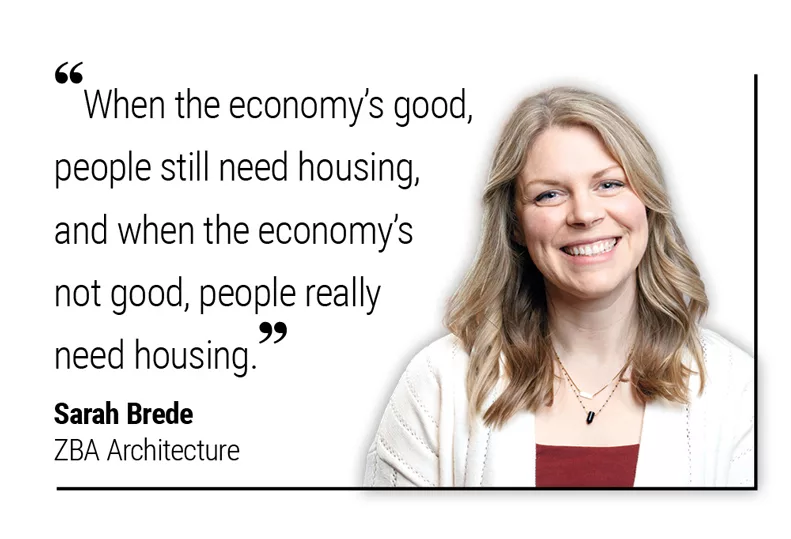
“There seems to be a never-ending pipeline of what we do,” Brede says. “When the economy's good, people still need housing, and when the economy's not good, people really need housing.”
ZBA’s design work includes single-family homes for first-time homebuyers, duplexes, apartment complexes, emergency and domestic violence shelters, farmworker housing, municipal buildings, and senior housing. ZBA also provides design services for renovations on existing affordable housing structures across the state of Washington and North Idaho.
“It’s the whole continuum of housing, from emergency all the way through homeownership,” Brede says of ZBA's design work.
Some of ZBA's clients include Avista Corp., Spokane County, the Martin Luther King Family Outreach Center, Community Frameworks, and Bethany Presbyterian Church, all of Spokane.
ZBA was founded in 1984 by principals William Zeck and Rod Butler. Operating as Zeck Butler Architects at the time, the firm focused on designing affordable, publicly-funded housing and other public projects, Brede says. Following Zeck's retirement in 2009, ZBA named architects Randy Vanhoff and Mark King as principals. Butler later retired in 2015, and the business was rebranded to ZBA Architecture.
Vanhoff and King promoted Brede as the firm’s third principal in May 2025 after she joined as an architect in 2008. The 12-person firm operates on the eighth floor of the Paulsen Building, at 421 W. Riverside, in downtown Spokane.
The firm’s affordable housing work has continued unaffected by the rebrand, she contends. The consistency of work is attributed to a regulatory environment surrounding publicly-funded housing resources that community organizations rely on — including tax credits, Washington state’s Housing Trust Fund, and the Federal Home Loan Bank.
The design company's extensive history with these complex compliance standards is routine for ZBA after more than 40 years, she adds.
“We have different budget constraints and lots of other criteria that we have to put into our projects. For anything with state funding, we have to meet the Evergreen Sustainable Development Standard, which is the sustainability focus on healthy housing,” Brede says. “We have lots of overlapping accessibility requirements that many other projects don't have to deal with, ... and they all apply. It gets a little tricky sometimes.”
The firm's residential design work typically serves households earning between 30% and 120% of the average median income.
“The vast majority of what we do is more missing middle,” she says. “It’s for your average (teacher) or police officer, or whoever is working in the community.”
While there is constant demand for middle housing, state funding priorities drive the specialized projects ZBA's clients pursue, she adds. For instance, ZBA's clients often receive project funding from the Department of Commerce via tax credits or the Housing Trust Fund, which invests in capital projects.
“(The state) shifts their priorities to homelessness and we see ourselves working on more emergency housing or shelters, and then they'll shift to seniors, and we'll be doing more senior projects,” she explains. “It’s where the funding priorities are at the moment, but the needs are just across the board. You could build anything and fill it right up.”
One recent project ZBA has helped design this year is the Vets on North Lacey housing development for veterans experiencing homelessness developed by Volunteers of America Eastern Washington & Northern Idaho and completed in January, at 6208 N. Lacey, in Spokane.
“Our shelter projects and most of our apartments have some component of homeless housing in them, so we’re always thinking about trauma-informed design when we’re doing those,” Brede says. “People, when they’re leaving a traumatic situation, they respond to their built environment a little more sensitively, and so we try to make sure that our designs respond to those needs and help them feel more comfortable in that space.”
ZBA also was involved in the Spokane County Fire District 8 Station No. 85 remodel, completed in April. The company's work on several fire station projects is attributed to principal Mark King's volunteer firefighter work, Brede explains.
Additionally, ZBA helped design a 22-unit affordable workforce housing development by Bethany Presbyterian Church, at 2607 S. Ray, on Spokane's South Hill, where two apartment buildings and one community building are underway for Bethany Village, the Journal previously reported.
The company’s predevelopment involvement with Bethany Village helps ensure that designs are tailored to the client's mission and the needs of future residents, she explains.
Additional projects throughout the region include Walla Walla Housing Authority’s Meadow Grove Apartments, an expansion project at the Liberty Park affordable housing campus in Spokane’s South Perry neighborhood, and a project at the Episcopal Diocese of Spokane’s Camp Cross, on Lake Coeur d’Alene.
“We have a lot of repeat clients, and they’re mostly folks who aren’t developers. They’re in social services, so they have a full-time job helping people all day long, and they’ve added a development to their workload,” Brede says. “Helping them through a big project like that means a lot.”

Stay Informed. It’s Free.
Subscribe to our newsletters and get the latest news and insights delivered to your inbox.
We respect your privacy.
Unsubscribe anytime.
Thank you!
You’re subscribed. Keep an eye on your inbox for the latest updates.