Native arts market opens in Airway Heights
Indigenous makers, artisans have new place to grow sales
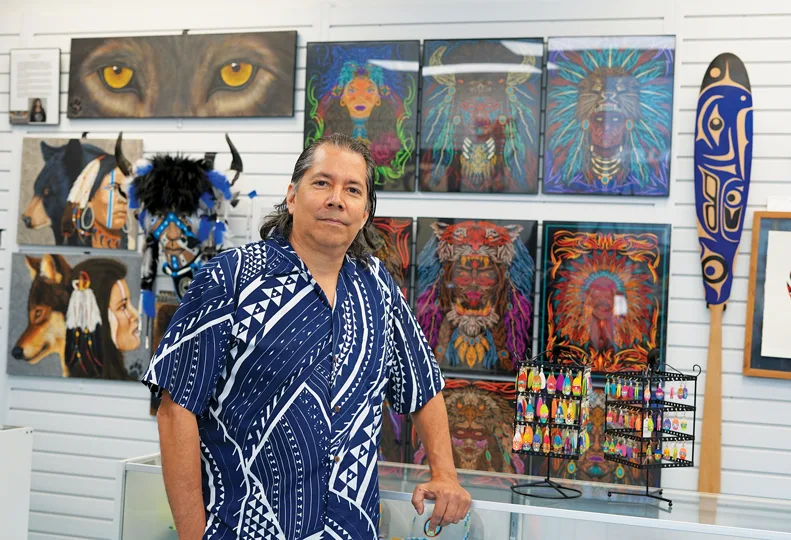
Spokane Tribe member Jeff Ferguson recently opened Battlegrounds Native Arts Market, in Airway Heights, through his nonprofit Elk Soup.
| Matt StephensAfter years of organizing events, supporting Native artists, and operating a nonprofit focused on Indigenous communities, Spokane Tribe member Jeff Ferguson has opened a new brick-and-mortar business designed to give Native artists a permanent place to showcase and sell their work.
Battlegrounds Native Arts Market recently opened on the West Plains, at 12924 W. Sunset Highway in Airway Heights, under the umbrella of Ferguson's nonprofit, Elk Soup, headquartered in Spokane. Currently, the market features the work of 23 Indigenous artists and artisans, with space available for another 20 to 25 creators, says Ferguson. The store's operating hours are Monday through Saturday from 10 a.m. to 6 p.m.
Ferguson co-founded Elk Soup with his wife, Margo Hill-Ferguson, in 2020, aiming to provide support and empowerment for Native American families.
By creating a centralized location for artists whose work is typically scattered across seasonal events and festivals, the market fills a critical need for economic stability and consistent public access to Indigenous art, he explains.
"This gives artists a place where people can find them year-round," Ferguson says. "Pop-up events are great, but they don't create longevity. They don't teach the sustainability that goes along with being a freelancer."
Establishment of the arts market was supported through a $10,000 SAGA grant awarded by Spokane Arts to Elk Soup. Ferguson says the funding helped complete the renovation of the space and move the market into the location.
The new venture marks Ferguson's sixth brick-and-mortar business. His previous retail operations focused on antiques and general merchandise. Battlegrounds Native Arts Market is the first store where Ferguson is able to sell his artwork alongside the work of other Indigenous creators. Patrons can find his photography on-site, featuring work from his 16 years of experience photographing in 30 U.S. states and 17 countries.
Battlegrounds Native Arts Market's business model is designed to maximize earnings for artists. Rather than taking a commission from sales, the business adds a 30% markup to the artist's asking price to help cover overhead and operating costs, he explains.
"We don't take our percentage out of the artist's price," Ferguson says. "The artist gets what they ask for, and our portion is added on top."
The store also aligns with the broader mission of Elk Soup, which is dedicated to supporting Native American families, Indigenous peoples, and tribal communities throughout the region, he says.
The storefront supports Elk Soup's four core objectives — arts and culture, education, entrepreneurship, and health and wellness — by transforming artistic expression into entrepreneurial success, ensuring that cultural preservation leads directly to improved economic health for Indigenous families.
"It's all connected," Ferguson says. "Artists are entrepreneurs. They're preserving culture. They're educating people through their work, and economic opportunity contributes to wellness."
Additionally, Ferguson says the market can help increase visibility for Interior Salish and Columbia Plateau tribal artists, whose work he believes is often underrepresented compared with Native art from other regions.
The market's long-term vision extends beyond retail sales, he says, explaining that he's considering an expansion to a larger space that would accommodate additional offerings. The extra room would enable Battlegrounds to host educational workshops and cultural classes, including beadwork, quillwork, leather working, ribbon skirt-making, and yoga classes.
Offering workshops will create opportunities for artists to generate additional income while helping preserve and pass along traditional Indigenous skills to future generations, says Ferguson.
His goal is to create more than a store. Ferguson says he envisions a community-centered cultural hub where artists can build sustainable businesses, share traditional knowledge, and strengthen Indigenous representation throughout the Inland Northwest.
"We want this to be a place where artists can grow," Ferguson says. "A place where culture can be shared, and where people can learn about who we are and the traditions we come from."
Small Bite
Twigs Bistro & Martini Bar will close its longtime South Hill restaurant, ending a 20-year run in the neighborhood dining district.
The South Hill restaurant at 4320 S. Regal will close in June. Twigs president, Trevor Blackwell, says the decision to close has been long-developing and was influenced by leasing challenges at the property.
"We've been on a month-to-month lease with the landlords for a while," Blackwell says. "They were looking for a longer-term tenant, and it just became apparent that it was time to move on."
The South Hill Twigs opened in 2006, says Blackwell, adding that after two decades, the company isn't abandoning Spokane's South Hill community.
"We'll be looking into another South Hill location at some point," he says. "Not immediately, but it's something we'll certainly consider in the future."
The South Hill closure comes as Twigs invests heavily the company's downtown restaurant, at River Park Square at 808 W. Main, which is undergoing a major renovation project that began in February. The remodel includes a relocated bar, expanded seating areas, a lounge-style dining space, and a new private dining room for events and business meetings. The downtown restaurant is expected to reopen by July, Blackwell says.