Aging adults exceed capacity for care
Washington state's older demographic impacts demand for housing, services
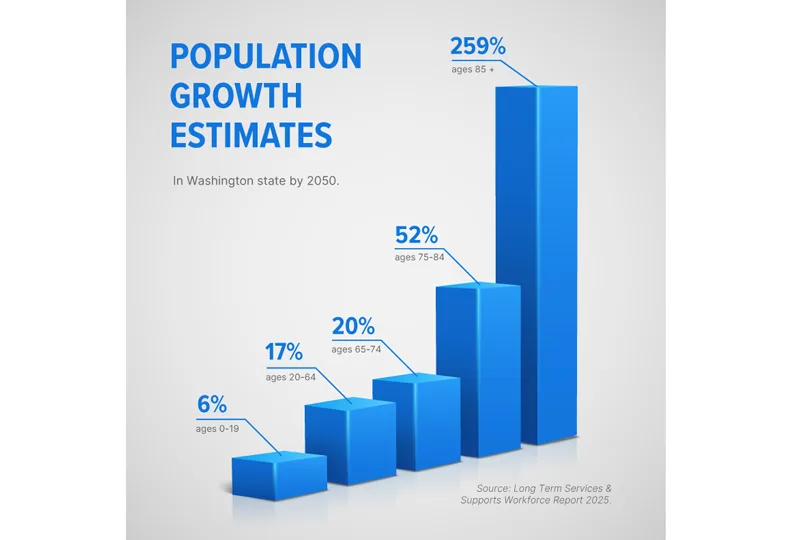
Projections indicate the population of Washington residents 85 and older will increase 259% in the next 25 years.
| Lily SidorenkoWashington state is on the leading edge of a demographic shift that is placing pressure on senior housing providers, long-term care operators, healthcare systems, and developers as the state's aging population grows substantially faster than the workforce and housing inventory needed to support it, according to state and industry reports.
The number of Washington state residents requiring long-term care services is projected to increase 55% by 2050, according to the Washington State Department of Social and Health Services' Long-Term Services and Supports Workforce Report 2025. The direct care workforce responsible for providing those services is expected to grow by just 17% during the same time.
The imbalance is mainly driven by the state's rapidly aging population. State projections indicate the population of Washington residents age 85 and older will increase 259% in the next 25 years, far outpacing the projected growth of every other age group. In comparison, the number of residents aged between 75 and 84 is expected to increase 52%, and the population of residents between 65 and 74 is projected to grow 20%.
Addressing the direct care industry shortfall will require efforts beyond workforce recruitment, according to the workforce report. Senior housing developers, assisted living operators, nursing facilities, adult family homes, memory care providers, and investors will face mounting demand as Washington's population continues aging.
The estimated population growth among Washington residents 65 and older is projected to increase to 2.3 million residents in 2050, from 1.5 million residents in 2025, an increase of 53.3%, according to the workforce report.
The makeup of that older population also is changing. In 2025, about 1 in 10 Washington residents age 65 or older will be age 85 or older. By 2050, 1 in 4 older adults will be at least 85 years old, according to the report. That shift carries significant implications because older adults generally require more intensive levels of care and support services, the workforce report shows.
Compounding the increased pressure is a shrinking ratio of potential caregivers. DSHS estimates there are currently about 36 working age adults between ages 15 and 64 for every Washington resident age 85 or older. By 2050, that ratio is expected to fall to just 12 working age adults for every resident age 85 and older.
Concurrently, the state's disability population also is expected to grow significantly. American Community Survey data estimates 1 million Washington residents currently live with a disability. By 2050, the number of residents with disabilities is projected to increase 46%, to 1.7 million people. The majority of people with disabilities are 65 and older, the report shows.
The demand for dementia-related memory care is expected to skyrocket as the number of Washingtonians with Alzheimer’s and other conditions more than doubles by 2050. This translates to about 138,000 new individuals requiring support, with over half of them expected to be at least 85 years old.
Demand for care services also is growing as providers continue to struggle with workforce shortages. Estimates by DSHS show Washington currently has 105,500 direct care workers, including nursing assistants, personal care aides, home care aides, and home health aides. Workforce projections indicate only about 20,000 additional workers will enter the field over the next 25 years. Direct care occupations historically have offered lower wages than comparable professions, creating ongoing recruitment and retention challenges for the industry, according to the report.
Workforce issues are unfolding alongside climbing senior housing occupancy rates and historically low development activity nationwide.
Senior housing occupancy reached 89.5% during the first quarter of 2026, marking the 19th consecutive quarter of occupancy growth, according to a National Investment Center for Seniors Housing & Care press release. Nationwide, independent living communities posted first-quarter occupancy of 91.1%, while occupancy at assisted-living properties reached 87.9%, and occupancy at nursing care properties climbed to 87.1%, according to investment center data.
Additionally, occupied senior housing units increased by more than 3,000 units nationwide during the first quarter, to 637,000 units, data shows.
Despite growing demand, new development activity remains limited. Investment center data shows that the number of senior housing units under construction has fallen to its lowest level since 2012. Year-over-year inventory growth dropped to a record-low of 0.4% during the first quarter of 2026.
"We aren't yet seeing new development pick up, and the bottleneck is largely on the capital side, not from lack of demand," Lisa McCracken, head of research and analytics for the National Investment Center for Seniors Housing & Care, says in a press release. "With elevated costs for labor and materials, and property valuation dynamics, many groups simply aren't ready to pull the trigger on projects just yet. As a result, investors favor acquiring existing properties over new construction, which puts pressure on the availability of senior housing for the consumer."
Senior housing occupancy rates are on pace to surpass 90% occupancy before the end of 2026, according to information from the National Investment Center for Seniors Housing & Care.
The organization notes similar pressures in active adult housing communities, which reported 91.2% occupancy in Q1 following a slight decline from the previous quarter. Only 464 new active adult units were delivered during the first quarter across nearly 130,000 units in the U.S. tracked by the investment center.
In Spokane, three properties and 238 units currently are in development including the 123-unit Vineyard Park North Spokane property, at 7609 N. Division, and two expansion projects adding 113 units at Riverview Retirement Community's 35-acre campus, at 1801 E. Upriver Drive.
Dustin Shandri, senior housing market specialist for the National Investment Center Market Analysis Platform, says the Spokane market is one of the more active smaller markets in the nation.
"Slower home sales may contribute to the dip in active adult occupancy since many older adults sell their home before moving to an active adult rental community," says Caroline Clapp, senior principal at the National Investment Center for Seniors Housing & Care, in the release. "Because active adult is a lifestyle choice rather than a decision based on an urgent need, prospective residents may be more likely to delay decisions in periods of economic uncertainty."
Together, DSHS and the National Investment Center for Seniors Housing & Care reports paint a picture of growing demand colliding with limited workforce growth and constrained housing development.
For Washington state, the findings suggest that meeting the needs of a rapidly aging population will require more than recruiting caregivers. Significant investment in senior living communities may be necessary to prevent demand from substantially outpacing available capacity moving forward.


_web.webp?t=1790233399)