Together Spokane creates new pipeline of work
DCI, Garco use progressive design-build model for athletic field improvements
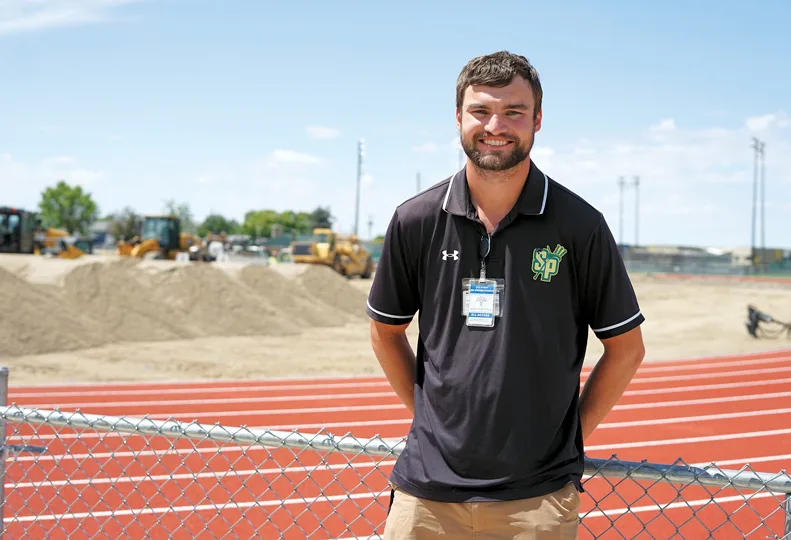
Beau Tilleman, athletic director for Shadle Park High School, says improved athletic facilities can make Spokane schools more attractive for statewide postseason play.
| Matt StephensConstruction is underway on new synthetic turf athletic fields at a pair of Spokane high schools, part of the Together Spokane initiative that is expected to bring stability for architects, engineers, and contractors in the region.
Valued at $8.7 million, the first phase of citywide field improvements includes a new football and soccer field along with a new baseball infield and dugout at Shadle Park High School, and new softball and baseball infields at Rogers High School.
The work is part of Together Spokane, the voter-approved long-term partnership between Spokane Public Schools and city of Spokane Parks & Recreation that combines a $200 million school bond and $240 million parks levy.
The Spokane office of Seattle-based DCI Engineers Inc. and Spokane-based Garco Construction Inc. make up the design-build team for all phases of Together Spokane's athletic field improvement projects, which eventually will include at least one all-weather rectangular multisport field with lights and one turf baseball or softball infield within each of Spokane Public Schools' five high school boundary areas for public use, a Spokane Public Schools press release states.
For Wade Gelhausen, principal with DCI Engineers, Together Spokane adds some stability to the Spokane market.
"The design industry faces a number of challenges," Gelhausen says. "Sometimes the jobs aren't there, we struggle with staffing issues at times, and there is a lot of competition in Spokane. Having a forward-looking program can certainly help feed our company, the industry, and the community for years."
Together Spokane will feature more than 200 community projects in Spokane over the next 20 years, according to its website.
DCI Engineers and Garco are working under a progressive design-build model, through which the two companies are working simultaneously on design and construction planning, explains Nicholas Hamad, planning and development manager at Spokane Parks & Recreation. Rather than waiting for designs to be fully completed before purchasing materials, the model reduces delays and offsets inflationary construction costs, while allowing teams to begin using the fields earlier, he says.
Bundling multiple field projects together also creates purchasing efficiencies through volume discounts while allowing work to proceed on an accelerated timeline, says Travis Schulhauser, executive director of capital projects for Spokane Public Schools.
Replacing natural grass with synthetic turf, coupled with the installation of LED sports lighting, will dramatically expand the amount of time the facilities can be used, Schulhauser says. The fields will accommodate practices and competitions into the evening while extending athletic seasons throughout much of the year.
The initiative is designed to create facilities that serve both students and the broader community, says Schulhauser.
Beyond construction efficiencies, school leaders say the upgraded facilities are expected to have lasting educational and economic impacts. The new fields will support expanded physical education programming and emerging sports, such as girls flag football, while creating venues capable of hosting district, regional, and state-level athletic competitions, says Beau Tilleman, athletic director at Shadle Park High School.
Improved facilities will make Shadle Park and other Spokane schools more attractive to the Washington Interscholastic Activities Association, or WIAA, which considers sites for postseason tournaments and championship events, Tilleman says.
WIAA governs interscholastic athletics and activities for hundreds of public and private middle schools and high schools across Washington state and oversees state championships and postseason competition, he adds.
"When Spokane schools have facilities capable of hosting postseason events, everybody benefits," Tilleman says. "Our student athletes gain the opportunity to compete on high-quality fields, our schools receive greater exposure, and visitors coming into the community spend money at hotels, restaurants, and local businesses."
Hosting postseason competitions also creates excitement throughout schools and neighborhoods while showcasing Spokane to athletes and families from across the state, he adds.
The upgraded complexes also are expected to generate fundraising opportunities for school booster clubs through concessions and tournament operations.
The Together Spokane initiative serves as a model for other communities looking to maximize public investments through partnerships, Schulhauser says. By allowing each agency to focus on its core expertise, Spokane Public Schools and Spokane Parks & Recreation have created a collaborative approach that other districts are beginning to explore.
"This really is becoming the new way of thinking," Schulhauser says. "When public agencies work together instead of independently, we're able to deliver more projects more quickly and provide greater value to the community."
Hamad, of Spokane Parks & Recreation, says the partnership allows the city and school district to maximize public investments while creating facilities that better serve the entire community.
"These are community assets," Hamad says. "By working together, we're able to deliver projects more efficiently and provide facilities that students, youth sports organizations, and Spokane residents can all benefit from."


_web.webp?t=1790233399)