EWU pushes forward with green energy plans
School's sustainability path includes solar array, carbon reduction, geothermal heat
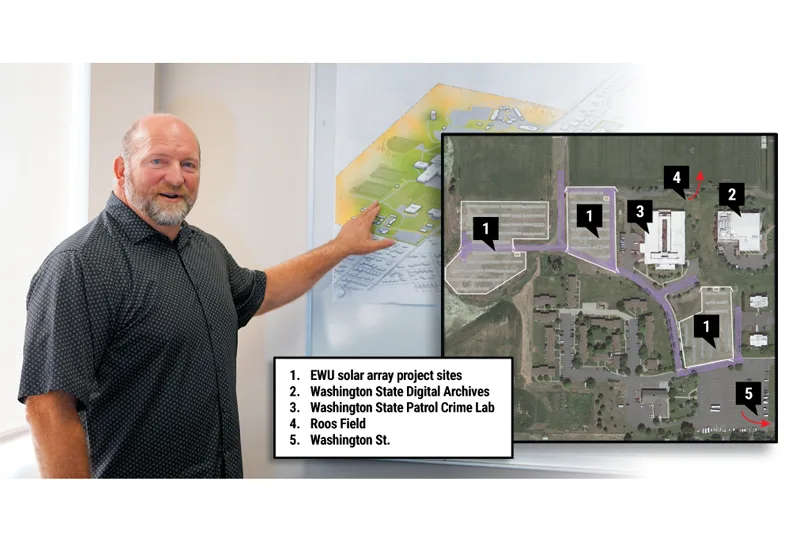
Kris Jeske, associate vice president of facilities for EWU, says the solar array will be located on the southern end of campus.
| Photo by Matt Stephens, map by Lily SidorenkoEastern Washington University is accelerating its sustainability efforts with a roadmap of projects including the implementation of a solar array, geothermal heating and cooling, carbon capturing, and a microturbine that uses existing steam production to create electricity.
These projects, among others, are all measures to reduce the greenhouse emissions produced at EWU. The university's long-term strategy is to make its campus a model for sustainability through consistent green energy installations, says Kris Jeske, associate vice president of facilities at the school.
Solar array
Currently, the university is in the early stages of installing a $7.1 million solar array. The nearly 1.5-megawatt, ground-mounted solar array will consist of three connected sections on the Cheney campus, says Jeske.
All three sections will be located on the south end of campus; two sections will be located west of the Washington State Patrol Crime Lab and south of the university's athletic practice fields, while a third will be located south of the crime lab and northeast of the Red Barn building that houses the school's police department.
The Washington State Office of Financial Management awarded funding for the project after the university put in a supplemental funding request last year, Jeske says. The funds became available July 1. The allocation represents the project's total cost and includes construction, design, permitting, taxes, insurance, and other expenses.
EWU plans to select an engineering and design team through a request for qualifications process this fall. Design work is expected to continue through the fall, followed by contractor bidding this winter, with construction beginning in spring or summer of 2027.
Once operational, the array is projected to offset about $54,000 in annual electricity costs, although that estimate could change as engineers finalize the design, Jeske explains.
The array is a grid-tied system that will cycle back into the grid and offset other energy costs. The solar development also advances a larger effort to change how EWU produces and consumes energy, he says.
Geothermal system
EWU has completed feasibility work and is seeking state funding for a geothermal system, which Jeske describes as the university's most consequential energy project over the next three to five years.
EWU's facilities function much like the infrastructure of a small community, Jeske says. The university operates roughly 3 million gross square feet of interior building space between its campuses and operates infrastructure needed to generate and distribute utilities to its buildings and grounds, according to university reports.
That scale makes heating buildings one of EWU's biggest opportunities for reducing emissions, Jeske says.
The centerpiece of its long-term efforts is a geothermal heating and cooling system, which Jeske explains would substantially reduce the Cheney campus's dependence on natural gas. He adds that the school currently burns natural gas to produce steam as its primary source of heating, but geothermal heat is a more efficient method.
"We're working closely with the state, trying to secure that funding," Jeske says. "That one will definitely have the single biggest impact on our energy use as a campus."
While a geothermal solution represents the long-term objective, EWU also is investigating technology that could reduce emissions from the natural gas systems it continues to operate in the meantime.
Carbon capture
The university received a $1.9 million Washington State Department of Commerce grant to pursue a carbon-capture system that captures carbon from exhaust produced by its natural gas boilers, Jeske says. The college had to commit $3.1 million in order to receive the grant, but prices have since escalated. A recent estimate of $6.7 million left a $1.7 million gap in funding, and Jeske says the school is working to fill that.
The school is partnering with Spokane Valley-based CarbonQuest Inc. and Seattle-based McKinstry Co. LLC to capture some of the carbon emissions from boiler vent stacks. The carbon is then liquified, processed, and can be sold in the form of carbon dioxide to companies, for example beverage manufacturers, creating an additional annual revenue stream of up to $200,000, he says.
The project would test novel technology that could remove up to 10% of the carbon from the system. The project also would give students an opportunity to work with emerging carbon-capture technology, he adds.
The carbon capture technology can serve as a bridge until EWU can make a larger transition away from natural gas through geothermal energy, but the eventual goal is to stop using natural gas altogether with a decarbonization plan, Jeske explains.
Microturbine
Another project uses energy the university already produces to create electricity. A microturbine steam generator, which is already operational, uses steam produced for campus heating and hot water to generate electricity. The system routes some steam through a small turbine and generator before allowing it to continue through the campus heating system, Jeske says.
At its peak, it produces 275 kilowatts, and is estimated to put out nearly 1.5 million kilowatt hours per year.
Because EWU already generates the steam, he says the turbine essentially recovers additional energy from an existing process.
The microturbine was part of a $20 million overhaul for the campus's Rozell Plant, and can save EWU about $95,000 annually while reducing greenhouse gas emissions, Jeske says.
Looking ahead
The university's goal is to reach essentially zero carbon emissions by 2040 while reducing the energy use intensity of its buildings below thresholds established by Washington state, Jeske says.
EWU currently produces roughly 11,000 to 14,000 tons of carbon emissions annually, an amount Jeske says isn't unusual for a university campus that functions much like a small city.
The university has been laying the groundwork for that transition for years, Jeske says. A university Energy Efficiency and Sustainability Plan established methods for reducing greenhouse gas emissions, incorporating sustainability into university operations, and identifying energy and operational savings across campus buildings, he explains.
That assessment included energy audits of 16 buildings and examined additional opportunities for water and energy savings, university reports show. The university identified both large-scale financing and phased construction as possible ways to implement efficiency projects over time, according to the report.
EWU's decarbonization plan lays out potential timelines for developing infrastructure in phases. An aggressive schedule could cost about $330 million through 2032, while a longer and potentially more realistic schedule could cost roughly $370 million through 2040, Jeske says.
Those figures could change substantially, and he says the estimates are now a bit outdated. Construction cost escalation means delaying individual phases increases their eventual cost, Jeske explains.
Together, the sustainability projects represent an effort to connect EWU's physical campus, decarbonization strategy, and academic mission, Jeske says.
"If we can be an example and we can leverage that and use that for education, fantastic," Jeske says. "Sustainability is something that we are really focused on."
Editor’s note: A previous version of this article included an incorrect quote from Kris Jeske regarding EWU's current power usage. Jeske misspoke during the interview. The quote has been updated to reflect that the array is a grid-tied system and it will cycle back into the grid and offset other energy costs.