2026 Rising Stars: Victoria Zsa Zsa Seebeck
Ranch hospitality helped shape sustainable boutique concept
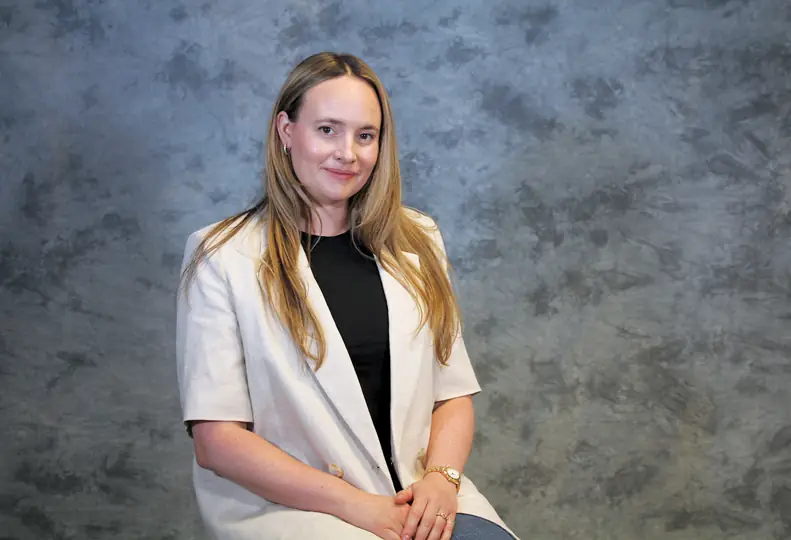
Victoria Zsa Zsa Seebeck is balancing one career as a retail entrepreneur and another as a construction project manager.
Raised on a seasonal guest ranch in Colorado with three sisters, Seebeck studied geological engineering at the Colorado School of Mines before earning her master’s degree in construction engineering and management from the University of Colorado Denver.
Several years ago, Seebeck, 36, moved to Spokane with her husband to be closer to his family. She launched a sustainable boutique, Sauvage Zsa, online in mid-2024 before opening a retail space at 122 S. Monroe, in downtown Spokane. The store offers clothing, gifts, and household items, and the physical location doubles as a wine club, called Santé Society. Sauvage Zsa also functions as a private event space.
Recently, Seebeck joined the Spokane office of Miami-based project and construction management company Consertus Inc. as a project manager. She’s now seeking a store manager to handle Sauvage Zsa’s day-to-day operations.
What was it like growing up on a ranch in Colorado? It was definitely a unique childhood and upbringing. In the winter, the resort would be closed, I would go to school, and then essentially right as school got out, we'd open the doors for summer business. It's a historic property, so I was always telling the story. Storytelling was always a big part of expressing the cultural heritage and appreciation part of it.
Like most properties in the U.S., it had significant Indigenous stories and heritage. It helped shape everything, from how I do business and my work ethic to how I treat the land and how I encourage others to walk gently on it. For Sauvage Zsa, I used a corporate social responsibility matrix, and a lot of the aspects of that were defined by my upbringing. I was raised in hospitality and retail.
What drew you to engineering? I just loved building. Growing up at the lodge, I was always working on different heavy equipment. It was work, but it was kind of playing. I didn't have any brothers, so I was always doing the dirty work and the hands-on work — problem-solving 101 at its core.
I feel like that's how engineering works, as well — you're just problem-solving, and there's different disciplines. I went to Steamboat Springs and went to community college there and kind of had a math epiphany. I took a math test … and I placed really high on it, and it kick-started my career in engineering. They immediately brought me into the mechanical engineering department.
Why did you create Sauvage Zsa? During COVID, I took a step back from my career in construction management and moved to Arizona to caretake for my mom and dad. My dad had dementia. He always wanted me to write my own story and have my own legacy; his was the Elkhorn Lodge.
I wanted to come up with something, as well. While I was caretaking, COVID gave me a chance and some time to really brainstorm and to get a little creative. I hadn't really tapped into that creative, artistic side of my background. During COVID, it was fun to go to the local shopping malls with my mom and dad, and I noticed a few areas of deficiencies that I thought could use improving.
The experience, for me, wasn't as fulfilling as it could have been. I came up with a business concept that disrupted the traditional model. I wanted to know who was making the goods. I wanted to create an environment that was nourishing and felt welcoming. I created Sauvage Zsa to make a lasting experience for retail and hospitality. It's an intersection of shopping with hospitality ... you can have a little glass of wine while you're shopping and I can tell you the story of the artisan who makes the products that you're looking at. I saw a need for a one-stop shop for small business, artisan goods.
Since you launched Sauvage Zsa, how has the store changed? When I first started this business, I thought that I would make everything and create everything. That really wasn't feasible — it takes a lot of time and resources to actually manufacture products.
I put some pen to paper and started creating this corporate social responsibility matrix that allows me to procure goods from other artisans. It gives me a filter to allow me to narrow down who I want to partner with and what I want my business offerings to look like. I specialize in artisan, minority-owned small goods.
I started with four small businesses that I partnered with to procure all the goods for (Sauvage Zsa), and now I'm up to 127 minority-owned small businesses that I work with directly to procure all of the goods for my store.
When you come and visit with me, my store is not just a reflection of my business, it's actually a reflection of 120-plus other small businesses as well that align with my corporate social responsibility matrix. That means that the goods are produced fair trade, they use ethical manufacturing, and they are produced by a minority-owned small business. Primarily, I work with women and women-owned small businesses across the U.S., and I try to provide a sustainable alternative to traditional goods.
Why did you include a wine club at Sauvage Zsa’s physical location? I sell a lot of specialty wine that is primarily from international vineyards, but I also carry a few domestic wines. I don't sell any wine that has any added pesticides or sulfites.
I try to stick with Old-World offerings and traditional winemaking. I don't really carry anything mass-produced. People kept saying, "Wow, you have some great wine, do you have a wine club?" So, I created Santé Society to fit the need. My offerings are different than other wine shops in town — I really only carry wines from small, specialized producers.

Stay Informed. It’s Free.
Subscribe to our newsletters and get the latest news and insights delivered to your inbox.
We respect your privacy.
Unsubscribe anytime.
Thank you!
You’re subscribed. Keep an eye on your inbox for the latest updates.