
Bouncing Back: Spokane's plans for rebuilding
City looks to accelerate permitting process while eliminating certain fees
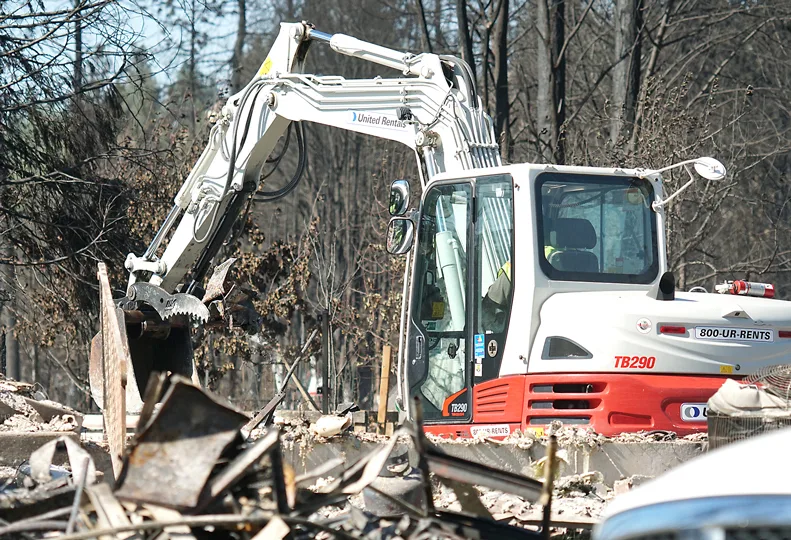
A worker removes debris from a burned property in the neighborhood around Spokane's Westgate Park, near Rifle Club Road and Highway 291.
| Matt StephensThe city of Spokane is preparing to accelerate debris removal, testing permits, and reconstruction efforts as property owners affected by the Spokane Complex Fires face what officials expect will be a lengthy rebuilding effort.
The fires burned hundreds of homes and torched nearly 10,000 acres, and the Spokane County Assessor's office estimates damages will exceed $1 billion, says Tami Palmquist, director of the city's Development Services Center.
City officials don’t yet know how quickly building permit applications will arrive or whether a surge could strain permitting staff. The timing will depend largely on homeowners working through insurance claims and deciding whether to rebuild the same home, construct something different, or leave affected neighborhoods, says Palmquist.
The city has open positions it could fill if additional employees are needed, as well as contracts with third-party reviewers that could provide additional capacity if applications begin arriving faster than city employees can process them, Palmquist says.
“Our anticipation is that we would prioritize these home permits to get people back to normality,” Palmquist says.
The city also reduced the demolition permit fee by 90% for affected homeowners as officials look for ways to remove financial and administrative obstacles during recovery, Palmquist explains. Those permits are now just over $30 for impacted residents.
Once properties are cleared, the recovery will increasingly shift toward construction activity. Some residents may rebuild essentially the same home, while others could redesign, change the size of their homes, or add accessory dwelling units, also known as ADUs, Palmquist says. Others may decide not to rebuild at all.
The city also is considering code changes that could give homeowners more flexibility to build ADUs during the recovery. One possibility would allow a homeowner to construct and temporarily live in an ADU while rebuilding their primary residence, Palmquist says.
City officials are working with residential plan companies to explore whether home designs could be donated to fire survivors, potentially reducing another expense and shortening the path between cleanup and construction, Palmquist says.
Building and planning departments from the city and Spokane County also will meet with the Spokane Home Builders Association and area contractors on Sept. 1. The meeting will give government officials and builders an opportunity to identify potential permitting and construction problems before rebuilding accelerates.
“Just hearing from both sides will benefit us all so that we can all be on the same page and move forward together,” Palmquist says.
Before many homeowners reach the building permit stage, however, they must navigate environmental testing, hazardous-material removal, and debris disposal requirements that form the first steps toward making burned properties ready for construction.
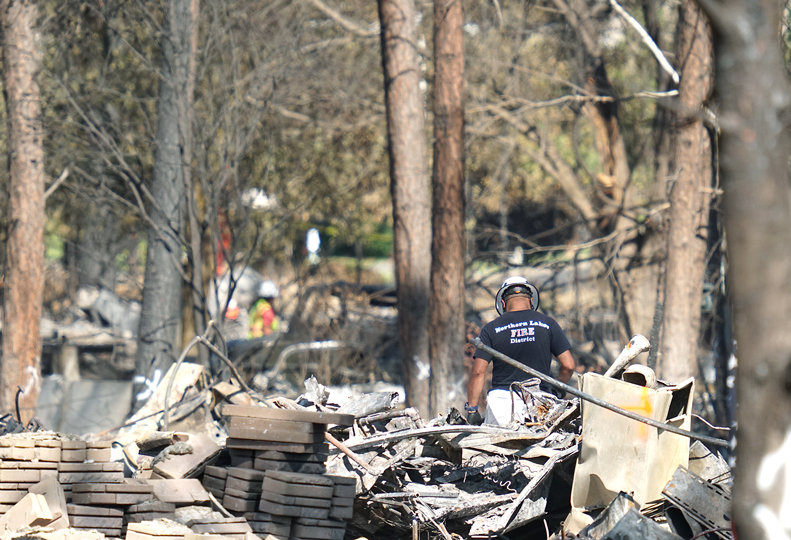 Workers from multiple agencies and fire districts have been helping in the cleanup efforts. Matt Stephens
 The U.S. Environmental Protection Agency began removing household hazardous materials from affected residential properties Aug. 18 as part of an operation requested by the Washington State Department of Ecology and assigned through the Federal Emergency Management Agency. The EPA has 60 days from the start of the operation to complete the work.
The EPA’s work doesn’t include general ash and debris removal or a complete asbestos survey. Property owners still must have their properties tested for asbestos before structural debris and ash can be removed.
Spokane Regional Clean Air Agency calls an asbestos survey by a certified building inspector the first step for property owners before removing ash and structural debris. The agency warns that wildfire debris may contain hazardous substances that become airborne when disturbed.
“We want people and their family members, as well as volunteers, workers, and others who may be handling fire debris, to be safe,” says Lisa Woodard, communications and outreach manager with the Spokane Regional Clean Air Agency.
The agency requires an asbestos survey even for newer homes because the construction date doesn't guarantee that a structure is asbestos-free, Woodard says. If no asbestos is found, the property owner or a Washington-licensed contractor can remove the debris. A Notice of Intent must be filed with Spokane Regional Clean Air Agency, and the asbestos survey must accompany debris to an approved disposal location.
Only the Graham Road Landfill, at 1820 S. Graham Road in Medical Lake, accepts asbestos-containing debris, Palmquist notes. If a survey identifies asbestos, a Washington-certified asbestos abatement company must handle removal and disposal of asbestos-containing ash and debris, she explains.
Spokane Regional Clean Air Agency has waived Notice of Intent fees and waiting periods for fire-affected properties, eliminating one potential cost and delay from the recovery process. A copy of the notice also is required before the city or county will issue demolition or building permits, says Palmquist.
“Our advice is really to follow the guidance that’s been issued by the (Spokane Regional Clean Air Agency) and the Spokane Health District,” Palmquist contends. “We’re dealing with lots of unknowns, lots of toxins.”
The concern extends beyond asbestos. Fire debris can contain lead, metals, plastics, and chemicals, and health officials recommend protective clothing and properly-fitted respirators when exposure to ash and debris can’t be avoided. Following the cleanup requirements can prevent homeowners and contractors from reaching another roadblock when they attempt to dispose of debris, Palmquist says.
“We all want to make sure that this is cleaned up and that people are able to move forward and rebuild their lives,” Palmquist says.
So far, the city hasn’t seen indications that asbestos testing or early permitting work is creating a substantial bottleneck, Palmquist says. The city already has received numerous asbestos documents, and some demolition contractors are coordinating work across multiple neighboring properties, she adds.
Spokane leaders are also taking notes from communities that have already confronted large-scale wildfire reconstruction, she says.
City officials met with Los Angeles County’s planning director to discuss lessons learned during recovery following the Palisades Fire in California, Palmquist says.
Spokane is looking into creating a recovery dashboard modeled after one used in Los Angeles County. The online tool could track affected properties, permit applications, and completed rebuilds, allowing residents and officials to follow the pace of recovery, Palmquist says.
The rebuilding process ultimately will involve a chain of public agencies and private businesses, she says.
For many homeowners, the progression starts with insurance and damage assessment, followed by EPA hazardous-material removal, asbestos testing, required environmental notifications, demolition, and debris disposal. The process then shifts toward architects, home designers, contractors, and government plan reviewers before construction and inspections can begin, says Palmquist.
Each property will move through those stages on a different schedule.
That could make the recovery less of a single construction boom, and more of a rolling series of projects that emerge as homeowners resolve insurance claims, complete environmental cleanup, and decide what they want to build, Palmquist says.




_web.webp?t=1790233399)