Catching up with: Eric Frickle, Kitchen Engine co-owner
Cafe, cooking school grow the store's retail operations
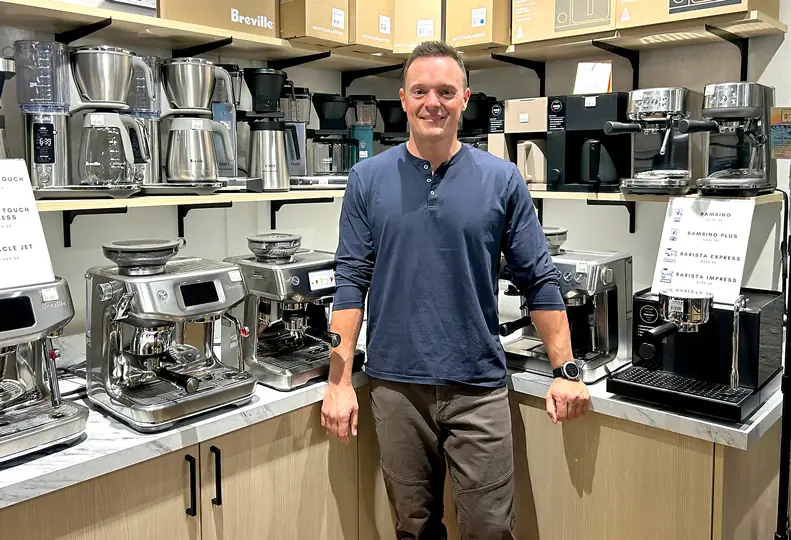
Eric Frickle founded The Kitchen Engine with his parents, Dan and Vicky Frickle, in 2006.
| Karina EliasWhen first walking into The Kitchen Engine store inside the historic Flour Mill building in Spokane’s North Bank neighborhood, it's not immediately noticeable that the cookware and appliance shop offers patrons much more than culinary products and equipment.
The Kitchen Engine, established 20 years ago this month, has undertaken two physical expansions at 621 W. Mallon, increasing its floor space to 5,000 square feet in size. The expanded space gives the shop more room to display products, and has simultaneously carved out a dedicated kitchen classroom that hosts weekly cooking lessons and a cafe that offers craft coffees and grab-and-go items such as pastries and sandwiches, says Eric Frickle, president and co-owner of The Kitchen Engine.
Growth has largely been driven by listening to customers, says Frickle, 44. Frickle says he's seen the business evolve from selling a variety of decor, such as tablecloths, plates, and wall hangings, to a dedicated kitchen destination, he says.
Frickle opened The Kitchen Engine in 2006 with his parents, Dan and Vicky Frickle.
“Within the first couple of years, we just let sales and customers dictate what we carried,” Frickle says. “If people want it, let’s keep it around, and if not, let’s get rid of it and try something new.”
Because The Kitchen Engine essentially functions as three businesses under one roof, many part-time employees are trained to handle retail, café, and cooking school responsibilities, he says. The retailer employs about 25 part-time workers. The cooking school and food-service departments are run by chef Jaime Aquino, who manages both departments, Frickle says.
The last time the Journal caught up with Frickle was in 2021 when The Kitchen Engine was getting ready to undergo a second expansion for the store’s kitchen classroom and cafe spaces.
The Kitchen Engine’s cutlery department stands in a former jewelry shop that moved floors in the Flour Mill, Frickle says. On the west corner of the store — the current site of the cafe and kitchen, previously was the home of The Chocolate Apothecary, which closed and remained vacant for several years before Frickle signed a lease to take it over, he explains.
Today, The Kitchen Engine hosts 25 to 28 cooking classes a month, with classes held on weeknights and twice on Sundays, Frickle says. The cafe, meanwhile, gives shoppers and visitors to Spokane's North Bank a reason to visit the space for coffee, tea, and pastries.
Chef Aquino coordinates a rotating lineup of instructors who bring different specialties to the classroom. Some are professional chefs or food business owners, and others are home-based cooks who have developed a deep expertise in a particular area, Frickle says. Most classes run for about two hours, but preparing for each one can take closer to 10 hours, which includes preparing ingredients, setting up stations, assisting during the class, and cleaning up afterward, Frickle says.
“It’s basically like setting up a restaurant to serve a single table,” he says.
Class topics range from cake and cookie decorating to pie making and sourdough bread, the latter of which Frickle says has become the longest-running culinary trend he has witnessed in his two decades in the industry. The sourdough trend took off during the pandemic, and unlike shorter-lived trends such as multicookers and sous vide cooking, has yet to fade, he says.
The dedicated classroom also allows The Kitchen Engine to offer substantially more classes than it could before the expansion. Previously, employees had to set up tables and chairs in the retail area for classes, effectively closing of part of the sales floor. The expanded kitchen features two-person workstations and an overhead camera that gives participants a bird’s-eye view of the instructor’s stovetop.
The cooking school offers another source of revenue, but classes are also a way to bring people through the doors, teach them something new, and get them excited about cooking, and ideally, about the products lining the shelves outside the classroom, he contends. The cafe and cooking school also give The Kitchen Engine something increasingly valuable for a brick-and-mortar retailer: an experience that can’t be replicated online, adds Frickle.
The retail side of the business has become increasingly challenging despite the popularity of the classes and cafe. Sales in the years immediately following the pandemic were largely in line with the company’s projections following the expansion, he says. Over the last two years, however, Frickle has noticed a slight decline in both foot traffic and the average amount of time customers are spending per transaction. Rather than customers cutting back, Frickle suspects many have changed how they shop.
“I think people are potentially buying it online because it’s more convenient,” he says.
Competing on price isn’t necessarily the problem. Frickle says customers sometimes come into the store after looking at the same product on Amazon only to discover The Kitchen Engine is less expensive. The harder thing for a brick-and-mortar retailer to compete with, he says, is the ease of having something delivered to the door.
To address demand for delivery, Frickle says he's considering ways to make The Kitchen Engine more convenient. One possibility involves expanding the store’s e-commerce presence by making more of its inventory available through the store's website. Frickle says he’s also considering smaller satellite stores operating in other Spokane-area neighborhoods.
Opening smaller versions of The Kitchen Engine in areas such as Liberty Lake, the South Hill, or the North Side, where customers could shop a smaller selection of products without making the trip to the Flour Mill. Products stored at a satellite location could be potentially transferred from the main store within a few hours, he says.
“Those are the ideas floating around right now if we want to keep it relevant and scale it a bit, but still have that locally-owned feel,” Frickle says of the next 20 years.