Catching up with: Brittany Tyler, owner of Fo(u)r Roots LLC
18 months after launch, Scale House Market exceeds expectations
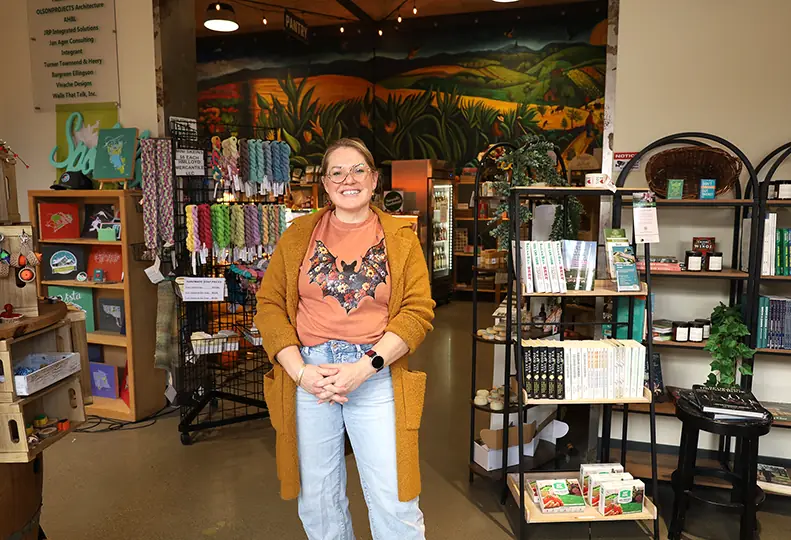
Scale House Market supports between 150 and 175 food-based businesses, more than doubling its initial goal of 65 vendors, says Brittany Tyler, owner and CEO.
| Karina EliasWhen Scale House Market opened in May 2025, the goal was to establish a year-round farmers market and support 65 farm-based businesses.
Eighteen months later, Scale House Market, a trade name of Fo(u)r Roots LLC, has surpassed expectations, supporting between 150 and 175 small businesses spanning agricultural operators, food producers, bakers, makers, artisans, dairy farmers, cattle ranchers, and others, says Brittany Tyler, Scale House Market owner and CEO.
Operating out of a former quarry scale house, the year-round market has been retrofitted to include a mercantile, a commercial kitchen, and an outdoor atrium that hosts seasonal markets and other events from May to August.
Located on the Spokane Conservation District’s 50-acre campus at 4422 E. Eighth, in Spokane Valley, the market was designed to address some of the limitations of traditional farmers markets, particularly seasonal operations, staffing demands, and the time farmers spent selling products instead of farming, says Tyler, a 2026 Spokane Journal of Business Person of Influence.
“Being able to take what we’ve built and kind of shift and adapt as we hear what the community is needing, ... and being able to kind of project into the future a little bit of what’s coming has been really cool,” Tyler says.
The market works in concert with the Spokane Conservation District — a local public entity — and the Spokane-based nonprofit Upper Columbia Resource Conservation and Development Council, forming a private-public-philanthropic model, she explains.
Similar to a traditional grocery store, at Scale House Market, farmers and producers are not required to be physically present to sell their goods. Instead, six full-time and two part-time employees handle administrative, procurement, mercantile, cafe, kitchen, and market management duties.
Depending on vendor needs, businesses can choose setup options from a single square foot of floor space up to a full or double booth footprint, Tyler says. Vendors maintain an individual sales profile in the market’s unified point-of-sale system, allowing customers to purchase items from multiple vendors at a single centralized checkout. The market collects a commission on sales while vendors receive weekly sales reports and direct deposit payments.
“There are intentionally several tiers of engagement when it comes to this model,” Tyler says. “Because we don’t want to say, 'You have to fit your square peg into this round hole, and that’s going to be what it is.' Small business doesn’t really work that way.”
A central part of the market’s mission is creating economically viable opportunities for farmers and small producers. Through a partnership with the Washington Small Business Development Center, which has an on-site office, emerging and established businesses alike receive mentorship and low- to no-cost business assistance.
Tyler declines to disclose the market’s annual revenue but affirms the business is profitable. She anticipates 2026 revenue will be similar to or slightly higher than 2025.
The Journal last caught up with Tyler three years ago when Fo(u)r Roots and the Spokane Conservation District were in the planning stages of developing the year-round farmers market.
A Spokane native, Tyler moved to the area in 2017 after spending 15 years away. She joined the Navy at 17, serving as a Chinese linguist, and later attended culinary school on the East Coast, where she worked as a pastry chef before returning to Spokane.
Through her involvement with the Inland Northwest Farmers Market Association during the pandemic, Tyler was exposed to some of the challenges facing the region’s food system, particularly as farmers lost sales channels and community members experienced an unprecedented spike in food insecurity.
To help address the issue, Tyler became involved with the U.S. Department of Agriculture’s Farmers to Families Food Box program, through which Tyler was able to distribute locally sourced food from farmers and food producers to hunger-relief organizations throughout Eastern Washington. In 2021, she established Fo(u)r Roots with Rachael Gewock and continued the work through the Washington State Department of Agriculture’s We Feed WA program.
What began as a distribution effort of about 300 food boxes per week, eventually grew to nearly 4,000 weekly boxes, Tyler says. Over five years, the organization distributed an estimated 6.5 million pounds of food across 13 counties through 23 partner organizations.
Collecting and distributing farm-to-table food boxes revealed gaps in the region’s food distribution infrastructure, particularly in terms of warehousing, cold storage, and staffing, Tyler says. The experience prompted her to consider more sustainable sales opportunities for farmers.
“We need year-round markets; we just didn’t have them in this area,” Tyler says.
In 2022, in partnership with the Spokane Conservation District, Tyler began exploring the feasibility of converting a former scale house on the property into a permanent food hub. The project received $750,000 in state funds to help design work and build-out, as well as a $1.2 million loan through the Washington State Department of Commerce Community Economic Revitalization Board, Tyler says. Tukwila, Washington-based Boeing Employees’ Credit Union is the primary sponsor of the project.
Today, in addition to providing a year-round sales outlet, Scale House Market offers educational programming aimed at strengthening connections between food producers and the community.
The market hosts Kids in the Kitchen classes, cooking workshops, and other educational events. Seasonal programming includes a winter market featuring dozens of small businesses during the weekend after Thanksgiving.
Plans for a food pantry locker program are underway in partnership with two western Washington organizations using the commercial kitchen to process surplus produce into food products for distribution.
Looking ahead, Tyler says the goal isn’t to expand the market’s physical footprint, but to improve its existing offerings and make greater use of the surrounding outdoor space.
“Our goal is to really dig into the quality of what we’re able to offer here,” Tyler says. “And keep it something approachable, really community-oriented, and something that is not necessarily just designed to get bigger, but to get better over time.”


Stay Informed. It’s Free.
Subscribe to our newsletters and get the latest news and insights delivered to your inbox.
We respect your privacy.
Unsubscribe anytime.
Thank you!
You’re subscribed. Keep an eye on your inbox for the latest updates.