Direct-to-consumer model yields positive results for local farms
CSA programs said to provide more consistent revenue

LINC Foods' LINC Box program operates year-round, providing hundreds of subscribers with locally-grown or produced food each week or every other week.
| LINC FoodsFor local farms, community-supported agriculture, or CSA, programs can create a more consistent revenue stream, reduce waste, and cut back on unnecessary labor.
“The idea of the community-supported agriculture is to help us buy everything needed to get the farm started,” says Shaneese Dunigan, who owns Courage to Grow Farms LLC with her husband, Phillip Moore.
A traditional CSA program, like the one offered by Dunigan’s small Whitman County farm, located about 45 miles southwest of Spokane in Lamont, Washington, is a direct-to-consumer model through which the consumer purchases a share of a farm’s harvest before or at the beginning of a growing season. Courage to Grow also offers a monthly payment option, its website shows.
Courage to Grow’s CSA program spans from April through December. Each week, Dunigan and Moore, with the help of their two kids, harvest the vegetables that are in season and deliver them to their CSA members’ doorsteps in Spokane, Kootenai, Lincoln, Stevens, and Whitman counties.
Each weekly share typically includes eight to 10 varieties of vegetables, which are harvested a day or two before they’re delivered.
“At the oldest, your food is only ever two days old,” Dunigan says.
Courage to Grow grows about 60 varieties of vegetables, but it partners with other local farms to offer add-on items for the CSA shares, including meat and fruit.
The cost to join Courage to Grow’s CSA program varies depending on which items members choose to add. The base share, which includes only vegetables, is about $50 per week, including delivery, Dunigan says.
The farm currently is offering a “late bloomer” subscription option that runs 24 weeks, from July to December, for $1,000, before any add-ons.
Dunigan estimates that about 75% of Courage to Grow’s revenue comes from its CSA program.
Courage to Grow currently has about 50 or 60 CSA members, but that number fluctuates, for example when a nonprofit purchases CSA packages from them.
“We have the capacity to serve anywhere up to 200,” Dunigan says.
By taking payments on the front end or through a subscription model, Courage to Grow’s CSA program provides the farm with more reliable revenue compared with selling produce at farmers markets, Dunigan says.
That consistent revenue stream is something that also benefits Sheila Grubb, owner of The Corner Farm, located just outside of Mead in the Peone Prairie area. Grubb specializes in growing culinary herbs.
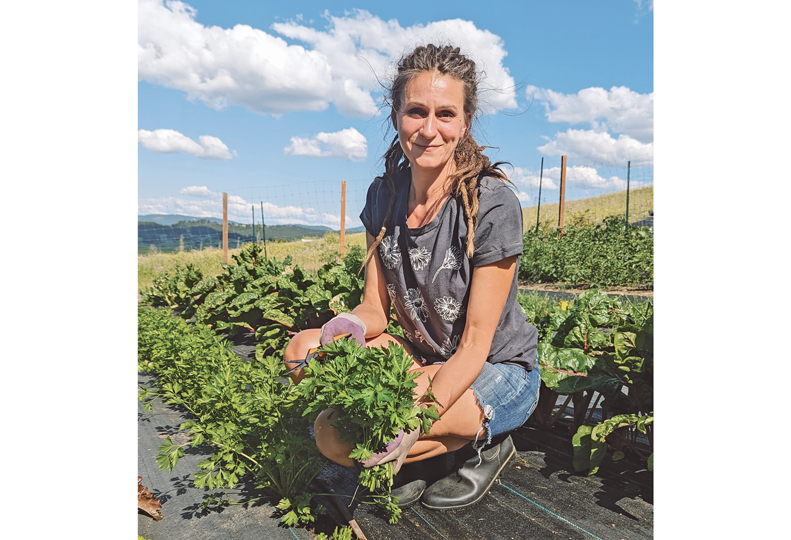 Sheila Grubb, owner of The Corner Farm, supplies LINC Foods with culinary herbs and other products from her farm just outside of Mead.
 -LINC Foods
“For my herb subscriptions, every single week I'm guaranteed,” Grubb says of the herbs she provides for LINC Box orders. “The number will fluctuate, but I kind of have a general idea.”
The consistency that comes with a subscription model isn’t always found when selling at a farmers market, she explains. Grubb says that for a market, she may spend all morning harvesting herbs or flowers, then set up a booth, then not sell enough of her products.
In addition to selling at markets and wholesale, The Corner Farm sells her culinary herbs, flowers, and other products through a less traditional CSA program with LINC Foods, a Spokane Valley-based farmer- and worker-owned cooperative.
LINC Foods’ CSA program is called LINC Box.
“LINC Box is a multifarm CSA,” says Michelle Youngblom, food enterprise director at LINC. “Rather than sourcing from one farm, we’re able to source from multiple farms every week to encourage diversity of product and have a really well rounded and balanced number of items that go out to people.”
The LINC Box program currently has about 400 subscribers. People can choose to pay up front, which earns them a small discount, or they can pay as they go, Youngblom says.
Subscribers can choose a “Farm Box” base option, which includes produce, or a “Ranch Box” base option, which includes rotating cuts of meat, like grass-fed beef, heritage pork, pastured chicken, and wild Alaskan salmon.
LINC also offers a wine box from Wildland Cooperative, which is located at Green Bluff, in Colbert.
LINC, an acronym for the organization’s legal name, Local Inland Northwest Cooperative Foods, has 13 employees. The cooperative is comprised of 31 farmer-owners, as well as a handful of employee owners.
The LINC Box program makes up nearly 30% of LINC’s food operations—the cooperative also operates a malt division through which LINC buys grain from local farmers, processes the grain at its facilities, and then sells it to breweries throughout the Pacific Northwest.
LINC Foods' other revenue stream is its wholesale program.
Like Courage to Grow’s CSA program, the LINC Box program allows customers to add additional items to their boxes. Subscribers choose to receive their box once a week or every other week.
Add-ons include items like fruit, herbs, eggs, cheese, bread, tortillas, pizza dough, and more.
LINC Box subscribers can have their food delivered to their homes if they live within 10 miles of Spokane, or they can pick up their boxes at one of many pick-up locations throughout the Inland Northwest, including those located in Coeur d’Alene and Moscow, Idaho, or as far as Richland, Washington.
The LINC Box program operates year-round. To fill in the gaps during the winter months, LINC sometimes purchases food from the Puget Sound Food Hub, located in Mount Vernon, Washington.
“In order to have a little bit more diversity than just potatoes, cabbage, carrots through the winter, we can bring in greens, radishes, and radicchio—more winter crops,” Youngblom says.
Operating year-round helps farms keep steady sales during winter months when there aren’t any farmers markets and customers aren’t buying their food as regularly, she adds.
Selling through a CSA program also helps farms sell all of their products.
“It is a way to move that product that maybe isn’t selling elsewhere,” Youngblom says.
Reducing waste is part of the motive behind Courage to Grow choosing to operate a CSA program.
When Courage to Grow began farming in 2019, Dunigan and Moore tried their luck at farmers markets.
Dunigan says they would harvest the day before each market, but if the weather was bad or they just didn’t get enough customers, they would end up donating much of what they harvested.
“It really wasn’t business savvy of us to go to farmers markets," Dunigan says. "That’s another reason we started the CSA program."
With the CSA program, Courage to Grow is able to harvest only what it needs. That also cuts back on unnecessary labor hours spent harvesting.
“For example, every week we know we need 50 shares of each item, and that’s what we’re harvesting, and nothing more,” she says.
As the farm-to-table movement continues to grow in popularity, so does the number of CSA programs in the area, Dunigan say, a trend she views as a growing community more than increased competition.
“I think just as technology and AI and other things increase, people naturally want to get more in touch with their neighbors, their farmers, the land,” Dunigan says.