
Bankruptcies tick upward in Spokane, Kootenai counties
Regional filings still below prepandemic levels

Lisa McBride, owner of Spokane-based McBride Law Offices, says the cost of owning a house is contributing to the increase in bankruptcy filings.
| Mike McLeanBankruptcy filings in Spokane and Kootenai counties have been on the upswing in recent years after having declined steadily for over a decade.
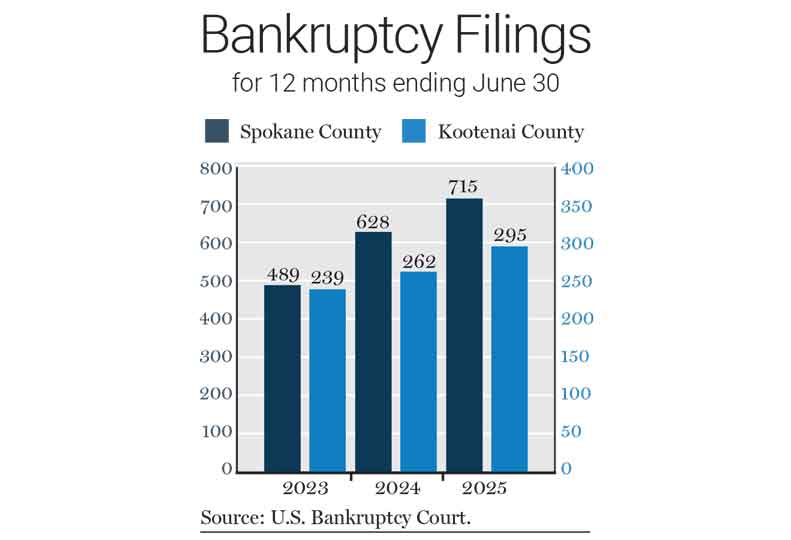
For the 12-month period ended June 30—the most recent year-long period for which directly comparable figures are available from the U.S. Bankruptcy Court website—bankruptcy filings in Spokane County totaled 715. That’s up from 628 filings in the year-earlier period and 489 filings in the 12-month period ended June 30, 2023.
Similarly, filings in Kootenai County totaled 295 for the 12-month period ended June 30, up from 262 and 239, in the respective earlier 12-month periods.
Lisa McBride, owner of McBride Law Offices, of Spokane, says the cost of owning a house is contributing to the increase in bankruptcy filings.
“People are beginning to have trouble making house payments,” McBride says. “House payments have gone up quite a bit along with taxes and interest rates … which cuts into your budget fairly significantly.”
Some homeowners seek bankruptcy protection to free up money from unsecured debt so they can afford to make their house payments, she says.
“People don’t lose their house in bankruptcy as much as they would have in the past,” she says. Washington state currently allows homeowners to exempt the median sale price of a house in the county they reside in, she explains.
“In Spokane County, that means you can have $437,000 equity in your home, which is a lot of equity,” she says.
Rebecca Sheppard, owner of Sheppard Law Office PC, of Spokane Valley, also says elevated post-COVID mortgage interest rates along with higher interest rates on adjustable-rate loans and credit are significant factors in the rising number of filings.
“The other thing I’m seeing is our cost to insure homes in our area after wildfires has skyrocketed,” Sheppard says.
In some cases, escrow payments have increased by over $300 monthly, she says.
“For people who are living paycheck to paycheck, that’s life or death,” Sheppard says. “They have to make a choice between continuing to make their required mortgage payment to keep a roof over their head and letting their unsecured debt slide.”
Other contributors to the uptick in bankruptcy filings in recent years likely include the expiration of COVID-relief measures, Sheppard says.
For example, the Washington state moratorium on evictions ended June 30, 2021, while the state’s moratorium on residential foreclosures expired July 31, 2022. A similar state mandate prohibiting wage garnishments expired in January 2021.
“Suddenly people were unable to service all of their debt that they incurred either just prior, or perhaps even during, COVID,” she says.
The most recent 12-month figures for Spokane and Kootenai counties are, respectively, 26% and 41% below the comparable period ending June 31, 2020, which represented mostly prepandemic filings.
Looking back at comparable periods for over 15 years, filings peaked at 2,646 in Spokane County for the period ended June 30, 2010, and at 1,055 the following period for Kootenai County—both in the aftermath of the Great Recession. Since then, numbers had fallen steadily until 2023 in Spokane and Kootenai counties.
Safa Riadh, principal attorney at Valiant Law, of Coeur d’Alene, says he doesn’t expect that the uptick in bankruptcy filings in recent years will approach the post-Great Recession peak in filings.
“I don’t think bankruptcy filing rates are going up (to historic levels) anytime soon,” Riadh says.
From a historical perspective, when the economy is struggling—or there’s a presence of war, natural disaster, or medical disaster—bankruptcy filings plummet and don’t increase until the economy is confident, he explains.
He contends there are currently too many “unknowns” about the future direction of the economy for people to pull the trigger on bankruptcy filings in historic numbers.
“Some people say the economy is recovering, some people say it’s not,” Riadh says. “Until people feel confident, I don’t think that bankruptcy filings are going to go back up.”
He says bankruptcy is an option that should be held close to the vest because it can be used only once every eight years.
“You can’t play your ace, which is bankruptcy, before you’re comfortable,” Riadh says. “If all you’re getting is phone calls and collections letters, let’s figure out how many bills you’re not going to pay before you file.”
However, he adds that some factors that might hasten clients’ decisions to show the bankruptcy card include lawsuits, wage garnishments, and medical debts.
While filings involving personal debt far exceed those with business debts, McBride says the share of business filings seems to be growing. In particular, she notes that some trucking businesses that have been in operation for over 40 years have closed recently and sought bankruptcy protection.
“They were saviors during COVID, and now they aren’t making it,” McBride says. “Some of it is due to fear of tariffs. It’s scary out there.”
In the most recent period, 3.9% of bankruptcy filings in Spokane County, and 1.7% in Kootenai County, were for protection from business debts. That’s up from 2019 prepandemic figures of 2.3% and 0.6%, respectively for Spokane and Kootenai counties.
Riadh says, “I’ve had more people who have had businesses that are needing to file in the last two years than in the previous four years.”
Government-backed loans issued during the COVID-19 pandemic have come due for some filers whose businesses have since failed.
“Some of the loans they were doing still have a personal guarantee,” he says. “Even if your business collapsed, you’re still on the hook.”
In Spokane County, 89% of business filings in the latest 12-month period were seeking Chapter 7 bankruptcy protection, up 9 percentage points from the comparable prepandemic period. In both years, nearly all of the remaining filings were seeking Chapter 13 protection.
Chapter 7 protection involves filers seeking to liquidate assets, while Chapter 13 protection involves filers seeking court-approved financial reorganization and debt repayment plans.
In most years, less than 1% of filings seek Chapter 11 protection, which involves the reorganization of the debtors’ business affairs.
Sheppard says that in Spokane County, however, Chapter 7 cases often involve very little liquidation, thanks to Washington state’s home-equity exemption.
“It’s providing people who otherwise would have filed Chapter 13 to file Chapter 7 and get a discharge of all of their unsecured debt and not have to worry about their house being liquidated,” she explains.
Riadh says exemptions that offer certain amounts of protection from bankruptcy are different in Idaho. For example, home equity is exempted up to $350,000 for a married couple in Idaho, which is significantly below the exemption allowed for Spokane County homeowners, he says.
“We did some Chapter 13 filings because people had too much equity in their homes,” he says.
Kootenai County, which had a 2024 population of 188,300, according to the U.S. Census Bureau, has a historically consistent higher rate of bankruptcy filings per capita than Spokane County, which had a 2024 population of 559,400.
Riadh notes that the minimum wage in Kootenai County is $7.25 per hour—far below Washington state’s minimum wage of $16.66 per hour.
“Wages alone are a significant factor,” he says.


Stay Informed. It’s Free.
Subscribe to our newsletters and get the latest news and insights delivered to your inbox.
We respect your privacy.
Unsubscribe anytime.
Thank you!
You’re subscribed. Keep an eye on your inbox for the latest updates.