Longtime Spokane interior design company changes hands
Design Works owner offers commercial, residential services
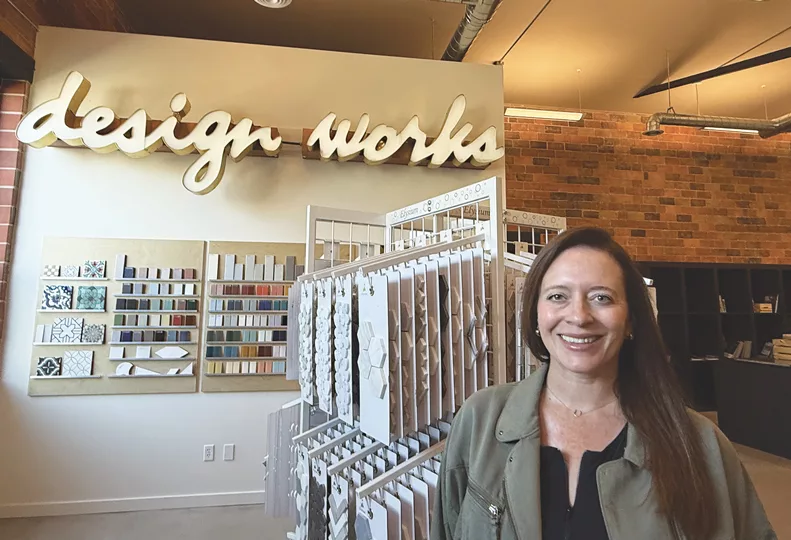
Natali Alexander stands in the recently renovated Design Works showroom, at 121 W. Pacific in Spokane, where customers can purchase materials including tile, flooring, and paint.
| Tina SulzleDriven by a passion for design and a desire to grow her business, Natali Alexander has acquired Design Works, making her the third owner of the longtime Spokane interior design company.
“I had been in the business for a long time, doing effectively the same thing,” she says. “I’m a designer, and I’m a licensed general contractor, but I didn’t have a brick-and-mortar. And I was already thinking about the next big thing and wanting to expand my business and do something more.”
Alexander purchased the 40-year-old design company from Don Manfred, who had owned Design Works since 1995, in June of 2024. Two months following the acquisition, she moved the company from a 4,000-square-foot showroom, at 2504 N. Division, to a renovated 2,700-square-foot showroom at, 121 W. Pacific, Suite 200.
“I didn’t have a brick-and-mortar, a shop actually selling materials," she says. "It was perfect timing for me.”
Design Works' showroom offers samples of design materials, including tiles, fabric, and flooring. She's adding a retail space to the showroom to feature design items sourced both regionally and from her international travels abroad to Mexico and the U.K. where she finds curated items for her clients.
The Design Works showroom is open Monday through Friday by appointment only.
Prior to purchasing Design Works, Alexander had operated from home, offering full-service design and project management under the company name Natali Alexander Design LLC.
Alexander's path to becoming a licensed general contractor was unexpected, she says. Her expansion to provide contracting services started when a client needed to replace a contractor on a home remodel and asked Alexander, the interior designer on the project, if she could get licensed.
“Most contractors come to the path of being a licensed general contractor through some piece of the construction world, which is probably why I was hesitant in the beginning,” Alexander says. “I’m not a plumber. I’m not an electrician.”
Holding the dual roles has been beneficial to both herself and her clients, Alexander explains.
“When you work with a designer as the contractor, the focus is on making sure the aesthetic ends up as it was intended,” she says. “And I think that piece of it is harder for people who don’t work in the aesthetic world. So, it’s been a good fit.”
Subcontractors provide both in-house administrative duties and perform some physical work for Design Works, including painting, carpentry, plumbing, and electrical services. A majority of the subcontractors Alexander hires have worked with the company for many years. Subcontractors also helped work on the renovation of the new showroom.
Commercial work performed by Design Works constitutes 15% of the company's current portfolio, with many projects involving the hospitality and wellness sectors. The remainder of the portfolio is comprised of residential work, she says. Alexander declines to disclose the company's expected annual income.
Design Works recently completed a commercial project at the Anam Cara Healing Center, located at 7 S. Howard, Suite 210, in the Symons Block Building in downtown Spokane. Formerly a physical therapy clinic, Alexander redesigned the multiuse wellness space with treatment rooms, a community space, and retail areas.
Commercial projects require a different perspective of design considerations compared to residential work.
“We had to ask, ‘How’s this business going to grow into this space without them having to go through another massive remodel?’” Alexander says of the healing center project.
Despite contrasting design perspectives, thoughtful design is essential across all types of projects — both residential and commercial, she notes.
“When it comes into the residential side of things, with people’s personal homes, clients are very invested in what the outcome is,” she says.
Commercial clients, however, are often more concerned with factors including cost effectiveness, durability, and functionality.
"They obviously still care how it looks, but they're not as personally invested in a beautiful, special tile," she says of her commercial clients.
Alexander's approach to commercial design work involves anticipating and considering the various ways people will be using the space. Successful commercial designs help to improve the mood of the built environment subtly, she adds.
“If you feel good in a space, and you maybe don’t even clock it consciously, it’s immediately apparent,” Alexander says. “If somebody hasn’t really been considered in the design piece of it, you feel it. You might not even be able to pinpoint it, but you feel it."
A fourth-generation Spokane native and graduate of Cheney High School, Alexander left the Inland Northwest to study art at Central Saint Martins, in London, where she graduated with a degree in theater design in 2005. Following graduation, she relocated to Los Angeles, where she produced high-level corporate events for tech companies, including Yahoo, Microsoft, and Amazon.
Her career path shifted while living in Los Angeles following a personal interior design project on her Japanese-inspired mid-century home, where Alexander completed the interior design work for the project. The experience led her to pivot from managing events to managing residential and commercial design projects and was later recognized by a notable publication.
“When we moved and had it photographed a few years later, it ended up in Dwell,” Alexander says, referring to a prominent design magazine.
In addition to the regional, hands-on projects offered by Design Works, Alexander offers remote consulting and design services. Outside of the Spokane area, she’s performed apartment renovations and consulted on several commercial projects, including restaurant concepts and retail buildouts in Oregon, Texas, and London — all of which were performed remotely.
“COVID really changed people’s expectation of in-person design work,” she says. “I hadn’t (provided) remote design until COVID, when everyone was used to doing things remotely.”


Stay Informed. It’s Free.
Subscribe to our newsletters and get the latest news and insights delivered to your inbox.
We respect your privacy.
Unsubscribe anytime.
Thank you!
You’re subscribed. Keep an eye on your inbox for the latest updates.