
River District reaches 1,000-home milestone in Liberty Lake
New business spaces, connections to nature, community underway
_web.webp?t=1759993312&width=791)
Jim Frank's development company, Greenstone Corp., has built 1,000 housing units and brought in a fresh wave of retail tenants at Liberty Lake's River District.
| Karina EliasFor developer Jim Frank, building a neighborhood is about designing walkable places where residents can make connections between home to community features, and maybe pick up a pumpkin from a shared patch, purchase bread from the local bakery, or walk to a bookstore or eatery without having to drive across town.
That philosophy is taking shape at River District, where about 1,000 residential units have been completed, says Frank, founder of Liberty Lake-based Greenstone Corp., which is spearheading the 900-acre community development.
In the past year, the development’s 40-acre mixed-use urban town center, dubbed NoLL, for North Liberty Lake, has anchored a fresh wave of new tenants, Frank says. The goal for the community is to move beyond conventional suburban sprawl, he emphasizes, and build a walkable community that blends housing, trails, and local businesses together, creating a lively and convenient community atmosphere.
“The walking infrastructure in Liberty Lake and the River District is the best in the region,” Frank contends. “It’s really a wonderful walking environment, and having services that people can walk to within their neighborhood is something that we found people really desire.”
New and upcoming tenants at NoLL are all family-owned and from the area, Frank says, adding that he is not interested in bringing in big national chains.
For instance, in July, Spokane-based Tamale Box LLC opened its second location and production facility in the town center. Spokane Valley-based Emrys Fermentations LLC, doing business as Emrys Beer & Mead Works, opened last fall in a 4,600-square-foot structure. Also at NoLL, Crepe Café Sisters, of Liberty Lake, is taking over a 1,400 square-foot retail space vacated by TT’s Brewery & Barbecue. Additionally, Spokane-based The Grain Shed bakery is currently in the process of opening a second location at NoLL.
Other businesses in the pipeline at River District include a bookstore, women’s clothing shop, and a bank branch, says Frank.
The commercial businesses are strategically placed throughout the district in what Frank calls "cluster developments."
“This is a large project,” Frank says. “We feel like we don’t want people to have to walk more than, say, half a mile for services. Part of it is trying to have some smaller neighborhood retail located closer to where you live.”
Frank is exploring the possibility of building a cinema, a project he has never undertaken before, he says. Permit information on file with the city of Liberty Lake show a proposed theater and parking lot would take root at 21790 E. Indiana on a vacant quarter-acre parcel just west of the 3 Ninjas Liberty Lake restaurant and the New Love Coffee shop. The contractor on the project is Chapman Homes LLC, of Liberty Lake.
“It’s a bit unusual to see new cinemas being developed now just because COVID really hit the cinema industry very hard,” he says adding that although there are many streaming services for people to watch, a cinema could also add to the community atmosphere he envisions at River District.
The cinema development would encompass four small theaters with reclined seating for 45 guests each. It could additionally be a venue for local filmmakers and artists to screen their work, he adds.
“We feel that people want to do that, they want those shared experiences, and people want to live in a place that has a sense of community,” Frank says. “We want to do it, but it’s not 100% guaranteed until we know all the permitting requirements.”
In addition to the retail expansion and entertainment venue considerations, the River District’s housing footprint continues to grow with the completion of about 1,000 residential units and more than 2,000 units expected to be developed, Frank says.
The mix of housing types includes traditional single-family homes, compact cottages on smaller lots, townhouses, and small-scale apartment buildings designed to fit within the neighborhood fabric.
“As time goes on, we’re concentrating more on trying to provide small homes on small lots,” Frank says. “Family sizes are shrinking, and a big portion of the housing market is single people. Not just young people but empty nesters and seniors are single as well.”
Frank also emphasizes building smaller-scale apartments — 12 to 18 units per building at most — instead of sprawling 200-unit complexes with large surface parking lots.
“We’re not doing large apartment projects anymore,” he says, adding that 100- to 200-unit apartment projects don’t serve the needs of the people in the community very well. "It’s my belief that if you live in a large apartment project, you don’t live in a neighborhood, you actually live in a project.”
One of the fastest-growing enclaves at River District is Trutina, a 55-and-older gated community, Frank says. The residential neighborhood is positioned on 80 acres of land, north of Interstate 90, and is bordered to the north and east by the Centennial Trail and Spokane River, to the west by Harvard Road, and to the South by Indiana Avenue. To date, about 300 single-level homes, cottages, townhomes, and apartments have been built, Frank says. He estimates adding between 100 and 200 more units in the future.
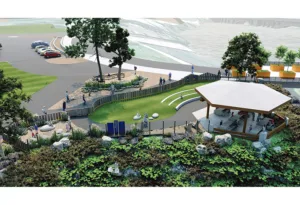
Last year, the Washington State Parks and Recreation Commission approved additional paths that connect to the Centennial Trail, Frank says. Improvements have recently been completed to the Harvard Road Trailhead, that connects to the Centennial Trail, including improved restrooms and a parking lot that has been paved and relandscaped.
From there, he adds, additional neighborhood trails will link down to the Centennial Trail, with separated paths running along Indiana Avenue west of Harvard Road. Parks and trails are designed by Michael Terrell Landscape Architecture PLLC, Frank says.
Adding to the community ethos vision is River District Farm, a five-acre orchard and garden, says Frank, who is a longtime gardener.
Located at 20291 E. Indiana, across from Orchard Park, the farm is managed by 40 volunteers from the community. It includes a 60-tree orchard made up of different varieties of apples, plums, and pears; a greenhouse; flower garden; vegetable beds; and a small farm store that opens two days a week during the summer months. Honey collected from the orchard's bee hives is bottled and sold in the store as well.
In 2024, volunteers donated 3,000 pounds of produce to area food banks through the Edible Tree Project, Frank says.
“(The farm is) probably one of the best community amenities that we’ve ever developed in a project,” Frank says. “It gets a lot of use virtually every day. The idea is to support local agriculture, provide local sustainable produce, and provide this community-building kind of activity that helps us develop the social fabric within the neighborhood.”


_web.webp?t=1790233399)
