
Inherent Biosciences eyes further growth in Spokane
HSSA grant funds help Utah-based startup expand its presence here
_web.webp?t=1770883270&width=791)
Eric Perez, operations coordinator at Inherent Biosciences' lab in Spokane, shows off equipment that technicians use to analyze DNA.
| Ethan PackSalt Lake City-based Inherent Biosciences Inc., a health care diagnostic startup, is growing its presence in the Spokane area since first expanding here in 2024 through $1.25 million in grants from Health Sciences & Services Authority of Spokane County.
Inherent Biosciences occupies 700 square feet of laboratory and office space on the first floor of the Ignite Building, at 120 N. Pine, located at the northeast corner of Pine Street and Martin Luther King Jr. Way, on Washington State University's Spokane campus.
In the last eight months, the startup has used two grants from HSSA to relocate 30% of its Utah operations to Spokane, where lab technicians conduct research and development on DNA testing methods, explains Inherent Biosciences CEO Andy Olson.
The company has one full-time employee and two contract lab technicians from the Spokane area.
Inherent Biosciences, founded in 2019 by Kristin Brogaard and Andy Olson, focuses on reproductive health, and especially on diagnosing infertility in men, says Olson. He co-founded Inherent Biosciences with Brogaard to conduct research in the field of epigenetics, or the study of how chemical modifiers that sit on top of DNA molecules determine gene expression, which can affect fertility in men, he says.
“All of our cells have the same hardware, the same DNA sequence, but they have different software that's turning on and off gene expression and causing those cells to develop into different cell types — skin cell, brain cells, eye cells, sperm cells,” Olson says. “And the reality in the biology is that there can be bugs in the software, and that's essentially what we detect. We detect bugs in the software of sperm cells, in the epigenetics of that sperm cell.”
Olson says he decided to apply his background in DNA-based diagnostics to men's reproductive health after learning about some friends who had issues with doctors unable to determine the reasons for their infertility.
“They had been trying to get pregnant for two years, spent $80,000 on treatment that didn't work, and they were diagnosed with unexplained infertility,” Olson says of his friends. “That's what really caught my attention. My background in my career has been in the field of molecular diagnostics, which is using DNA-based technology to diagnose a clinical problem and guide treatment. When I found out about this problem, I started looking into why it's unexplained.”
Olson's research found that, while women's fertility testing can be extensive, ranging from blood tests and ultrasounds to minimally-invasive surgeries, about 50% of infertility issues are attributed to male factors like sperm defects. Additionally, fertility testing for men relied on decades-old methods.
Inherent Biosciences has established a market brand, Path Fertility, under which they sell a testing product SpermQT, which tests the quality of sperm to determine how healthy it is, Olson says. The company has also licensed epigenetics research intellectual property from both Washington State University and the University of Utah, in Salt Lake City, so it could be commercialized.
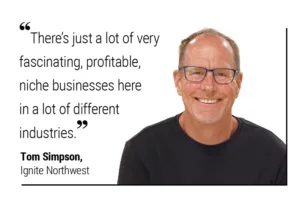
Olson, who grew up in Spokane, reached out to a mentor in the field of epigenetics, Lewis Rumpler, for help to find funding in the city of Spokane’s startup ecosystem. Rumpler, currently the finance committee chair at HSSA, helped Olson connect with Spokane investors, including Tom Simpson, president of the Spokane Angel Alliance and CEO of business accelerator Ignite Northwest.
“Some of the very first funding that we were able to get was from investors in Spokane, and (Simpson) was instrumental in connecting me with other investors (here),” Olson says.
Inherent Biosciences has also applied for and has been awarded additional grants from the National Institutes of Health to fund additional research and development efforts, he explains.
Following the NIH grants, Inherent Biosciences contracted Allele Diagnostics, a Spokane-based startup that provides genetic testing including prenatal and pediatric diagnostics, to help with epigenetics research and development in Spokane ahead of Inherent Biosciences establishing a presence in the area, Olson explains.
Allele Diagnostics had been awarded a one-to-one matching grant for bioscience-based economic development in Spokane County by HSSA previously and Olson decided to apply for a similar grant.
Inherent Biosciences raised $250,000 from qualified Spokane investors and was awarded a matching $250,000 grant by HSSA in April 2024, he explains.
“We were very successful in executing and hitting our milestones with the phase one grant and the HSSA match,” Olson says. “Then we applied for a (phase two) matching grant to continue the build out of our research and development lab and hire people in Spokane, and we were able to get that matching grant from HSSA for $1 million.”
Olson says expanding the company’s research and development work here and scaling its testing capacities through the use of new sequencing technology from Oxford, England-based Oxford Nanopore Technologies, has increased the startup's sample testing capacity by about 50%.
Olson, Brogaard, and several other researchers also published a research article in the Journal of Assisted Reproduction & Genetics in January 2026, which shows the clinical value of epigenetic sperm assessment as part of male fertility evaluation.
Olson says he's considering relocating permanently back to Spokane from Utah in the future, as self-described empty nesters, Olson says he and his wife want to make Spokane a place for his children to visit.
“I would love to move there as well,” he says. “Let's find a really great place in Spokane that our kids want to come visit and make it one of those destinations where everybody wants to come because it's so fun and it's such a great place. That's my long-term goal.”

_web.webp?t=1790233399)