Wildfires add to Fulcrum's growing workload
Environmental consulting firm looks to hire, expand with new satellite location
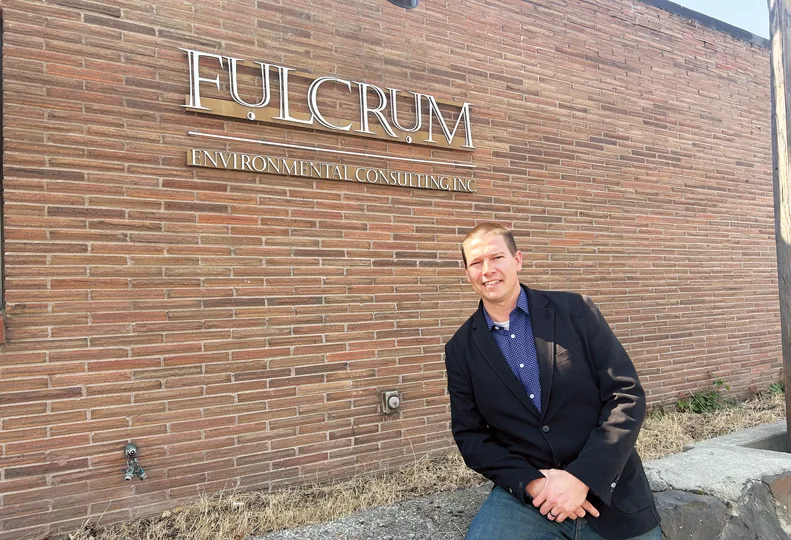
Scott Groat, regional manager for Fulcrum Environmental Consulting, says the wildfires have increased the firm's workload as it tests buildings and sites for toxins.
| Karina EliasAs the focus shifts from containment to recovery in the aftermath of the Spokane Complex Fires, work for Fulcrum Environmental Consultants Inc. has picked up as the group of scientists makes its way around the city testing homes, schools, soil, and air for hazards people often can’t see.
The wildfire response is only one part of a growing workload for the Spokane-based environmental consulting firm located at 207 W. Boone, in the city's North Bank neighborhood.
Over the past decade, Fulcrum’s work has evolved as contaminants such as PFAS, also known as “forever chemicals,” have come under greater regulation, and longstanding hazards including asbestos, lead, and radon gas continue to drive demand for testing and abatement.
“(The phone was) ringing nonstop last week,” says Regional Manager Scott Groat. “We’ve been very busy. We’ve been answering a lot of questions from people that work in the schools, homeowners themselves, and different insurance-type folk that are involved with losses around here.”
Wildfire smoke can potentially carry asbestos fibers, heavy metals, and other toxins released when building materials and household components burn, Groat says. According to the Spokane Regional Clean Air Agency, burned structures must be tested for asbestos before debris can be taken to a landfill or transfer station.
A completely burned home might take about half a day just to do initial field sampling, followed by a waiting period of five to seven days for test results, he says. If asbestos or other toxins are found on a property, the testing and abatement process could take between one and two months to complete.
With hundreds of affected properties, capacity becomes an issue because there are only so many consultants and abatement contractors, he says.
Wildfire smoke can also impact homes and structures that didn’t burn down, he says. Fulcrum can test homes for soot, asbestos, airborne particulates, and hazardous contaminants to determine if environmental hazards exist. The firm will often get pulled into these types of jobs by insurance companies and homeowners. Groat adds that air purifiers can be sufficient for smoke odor if they use a carbon filtration system.
The wildfires have also created substantial school district work for Fulcrum, Groat says.
Fulcrum has been testing school buildings close enough to the wildfires to have potentially been affected by the smoke, including structures within the Nine Mile Falls School District, Mead School District, Spokane Public Schools district, and the Nespelem School District, located on the Confederated Tribes of the Colville Reservation, northwest of Spokane.
“We’ve been doing a lot of particulate testing at the schools to make sure it’s safe for the staff and for the children to get back to school,” Groat says. “We were running around at all hours of the night and day doing testing.”
The wildfire response is adding to an already busy workload for Fulcrum as it considers hiring more field staff and possibly expanding its regional footprint.
Founded in 1991, the Spokane office has nine employees, including certified industrial hygienists, hydrologists, geologists, certified hazardous-material managers, asbestos project design specialists, and administrative staff. The firm opened a second office in Yakima, Washington, in 1994, which is operated by a team of 12, he says. A possible third location is being mulled over for either Pullman, Washington, or Coeur d’Alene, he says.
Companywide, Fulcrum has maintained a steady 10% revenue growth year over year. He estimates 2026 annual revenue to be around $5 million, Groat says.
While the wildfires are currently driving much of Fulcrum’s work, the firm’s scientists spend their days dealing with a wide range of environmental hazards.
The biggest change in the environmental consulting landscape over the past decade has been the growing regulations surrounding per- and polyfluoroalkyl substances, or PFAS, Groat says.
Fulcrum does extensive work at Fairchild Air Force Base, where PFAS contamination from firefighting foam used historically to extinguish jet-fuel fires has seeped into soil and groundwater, Groat says. The firm conducts soil and groundwater testing and provides oversight when contaminated material is removed or disposed of.
Much of Fulcrum’s work also involves environmental hazards that have been known about for decades, such as lead and asbestos.
At Eastern Washington University, for example, Fulcrum recently conducted large asbestos and lead testing for the school's Dryden Residence Hall.
Asbestos and lead testing has also become a constant source of inspection for the firm at dams across the country. Many U.S. dams that date back to the 1930s through the 1960s contain asbestos and lead, Groat explains. Dam workers doing maintenance and upgrades on turbines — the large machines with curved blades that spin when rushing water pushes through them — face exposure to the hazardous materials. Fulcrum develops work plans for contractors, observes work, and performs clearance testing before systems are returned to service, he says. Grout says there aren’t many regional dams the firm hasn’t worked on, including the Grand Coulee Dam, McNary Lock and Dam, Priest Rapids Dam, Boundary Dam, and the Chief Joseph Dam, also known as “Big Joe.”
Asbestos remains prevalent because of how expensive it is to abate, and the fact that it can legally remain in place if it's intact and undisturbed, he says. Spokane has many older buildings and homes that are undergoing renovations and must be inspected before demolition or construction disturbs those materials.
The industry once imagined that asbestos work would eventually disappear. Instead, buildings Fulcrum inspected 20 years ago are beginning another renovation cycle, he says.
Radon is another concern throughout the Inland Northwest, Groat says. Unlike asbestos and PFAS, the naturally occurring radioactive gas is prevalent in Spokane and surrounding counties due to the region’s geology. It is colorless, odorless, and tasteless, making it hard for humans to detect, yet important as it’s the second leading cause of lung cancer.
“A lot of the places we test come up at levels that are higher,” Groat says. “It’s surprising we don’t do more of it because it’s the number one cause of lung cancer outside of smoking.”
Homes and buildings that reach or exceed four picocuries per liter, the threshold level recommended by the U.S. Environmental Protection Agency, are recommended to take action. A radon mitigation system was installed beneath the firm's Spokane location after it learned the building had a radon level of 30 pCi/L, he says. While Groat recommends that everybody test their home for radon, a radon mitigation system is not always required, he says. Many people can use their heating, ventilation, and air conditioning systems to increase airflow in a space, he adds.
For now, much of Fulcrum’s work is focused on the aftermath of the wildfires, he says. The firm is currently developing an online master work plan with guidance for people whose homes were directly impacted by the fires or adjacent to them, he says.