Future amenities eyed for The Course Spokane Valley
First phase of cross-country venue's construction wrapped up in October
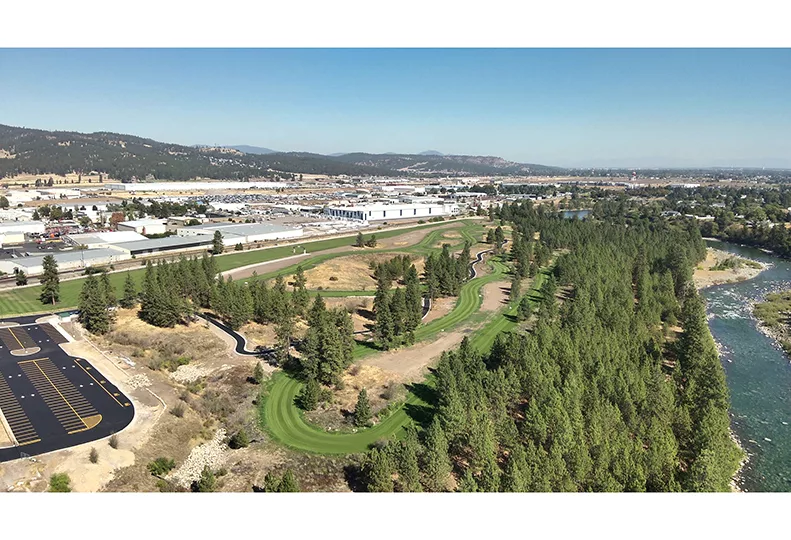
The Course Spokane Valley's cross-country track winds through a grove of trees, an appealing feature to many runners.
| City of Spokane ValleyAfter completing the first phase of construction of The Course Spokane Valley last month, the city of Spokane Valley and its project partners will use the 2026 cross-country season to determine plans for a second phase of development.
“Once we have a season under our belt, then the different components of phase two will come into play,” says John Hohman, Spokane Valley’s city manager. “We'll have a better idea of what we can construct out there or add out there that would just elevate the whole project.”
The Course Spokane Valley — which will host cross-country races from the middle school to master’s and post-collegiate levels — is located on 46 acres of Spokane Valley park property at 2520 N. Flora Road.
The city is working on securing an additional 16 acres of forested land located between The Course and Spokane River as part of the project, says Erik Lamb, Spokane Valley deputy city manager. That land is owned by Washington State Parks, and the city is seeking a long-term easement to fully incorporate and manage the land as part of The Course.
Phase two improvements under consideration include the addition of a field house with a media booth, a medical and drug testing location, a timing suite, a training room, and officials’ offices at the property.
“The field house is a welcomed addition once we’re able to secure funding for that,” says Ashley Blake, CEO of Spokane Sports.
The Course currently has limited parking, Blake adds, and city officials and Spokane Sports are relying on shuttles to bring visitors to and from an off-site commercial parking location.
"We're looking at up to 12 events for 2026, and really finding some innovative parking solutions will help that help logistics run smoothly for those major events,” she says.
Other potential future improvements include additional bathrooms, picnic structures, an area for food vendors and food trucks, an awards area, and a crow’s nest observation tower for announcers, Hohman says.
“We need to work on learning how this project will function in the real world, in these real events, and then look at how do we bring those amenities to make it even better?” Hohman says.
Other phase two improvements would enable more sports to use the location, Blake says.
“As we continue to operate the facility, we have some attributes that we want to incorporate into it … as well as what additional sports we could host at the site. So looking at building some features for cyclocross, archery, orienteering — just a handful of additional sports that we could host in addition to cross country running,” she says.
Cyclocross races take place on a closed circuit with competitors racing multiple laps on bicycles, according to USA Cycling's website. Orienteering is the sport of navigation that combines running and walking with map-reading in order to navigate a course, according to Orienteering USA's website.
The city purchased the park property in 2020 from the Washington state Department of Transportation with the help of a $1 million Washington Wildlife and Recreation Program grant. Construction of phase one began September 2024 and was completed on Oct. 27, 2025, according to a press release. The Spokane office of Turner & Townsend Heery LLC managed the project. Spokane-based Walker Construction Inc. was the general contractor and Spokane-based SPVV Landscape Architects was the landscape architect on the project.
Spokane-based nonprofit Spokane Sports, which programs events that will be held at the venue, advised the city on the course design and layout, says Blake.
Phase one involved the construction of a grass course, with 5K, 6K, 8K, and 10K loop options, and infrastructure, including restrooms, parking, a shuttle drop-off point, and a pedestrian pathway.
The first phase cost an estimated $7 million dollars to build, 99% of which came from lodging tax revenue in 2023 and 2024, says Hohman.
Funding for phase two could come from lodging tax revenue, similar to how phase one was funded, but also could come from other sources like grants, private donations, or sponsorships, Hohman says.
“The city is very adept at finding outside money for things, so we'll do our best to minimize any local dollars spent on it,” he says. “I think there's a lot of companies that would want to be associated with these larger events and get noticed. If you have thousands of youth runners coming to a Nike event, I think (advertising) goes a long way."
The Course is being managed by Spokane Valley's parks and recreation department. If the city chooses to contract the maintenance out, Hohman estimates the cost to be around $260,000 per year. The money would come from lodging tax funds.
Spokane Valley officials expect to see an economic benefit estimated between $2 million and $5 million a year, Hohman says. If all of the events Spokane Sports is trying to book in 2026 occur, the economic benefit will be about $10 million.
“I’m just super excited about the economic impact that's going to come and all the families that get to see what Spokane Valley is about,” says Spokane Valley councilmember Jessica Yaeger. “(We want to) give them a good show.”

Stay Informed. It’s Free.
Subscribe to our newsletters and get the latest news and insights delivered to your inbox.
We respect your privacy.
Unsubscribe anytime.
Thank you!
You’re subscribed. Keep an eye on your inbox for the latest updates.