Spokane's 27 by 2027 takes root in West Central
Road safety projects lay foundation for citywide walking, biking network
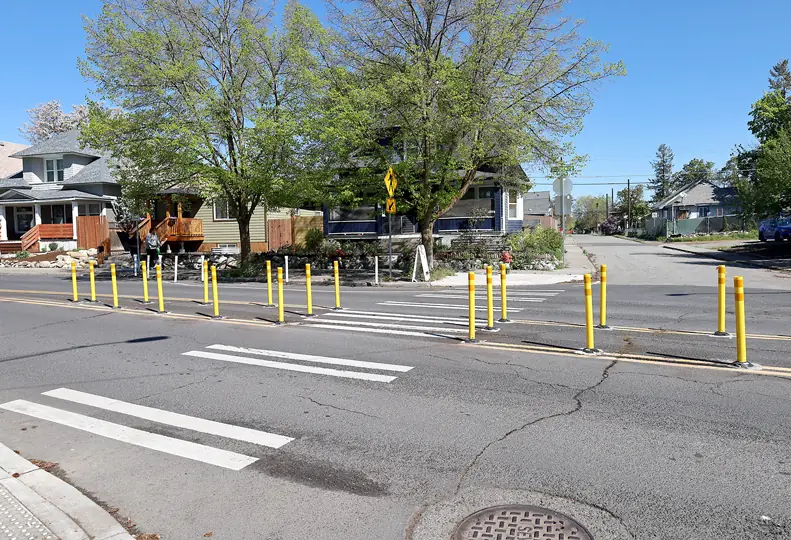
Traffic bollards at the intersection of Chestnut Street and Dean Avenue, in West Central Spokane, have been installed to slow traffic and improve pedestrian safety.
| Karina EliasAfter more than a decade in the works, long-planned infrastructure projects in Spokane’s West Central neighborhood are beginning to take shape, with the first wave of street, sidewalk, and bike network upgrades now complete.
Dubbed the West Central Infrastructure Project, the community-led effort has identified 10 priority multimodal transportation safety improvements for the neighborhood. Improvements have been financed through a mix of funds, including the West Quadrant Tax Increment Finance District and the American Rescue Plan Act, totaling roughly $600,000.
The plan was developed in partnership with the city of Spokane, Spokane Transit Authority, neighborhood groups, and a team of consulting firms, including the Spokane offices of Coffman Engineers Inc. and Kittelson & Associates Inc.
The work also serves as a foundation for the city’s broader multimodal vision, dubbed the 27 by 2027 Urban Mobility Network, which aims to create a fully connected 27-mile system of safe walking and biking routes linking neighborhood streets to major corridors in all quadrants of the city by 2027.
Colin Quinn-Hurst, senior planner with the city of Spokane, says of the 10 priority projects, four have already been completed, with additional projects in the design phase to be built next year.
Wende Wilber, senior principal planner at transportation engineering and planning company Kittleson & Associates, says the scope of the improvements was determined by neighborhood residents, including the West Central Neighborhood Council and REACH West Central, with the city supporting their findings.
“It was really a committee of neighbors that led the project,” Wilber says. “And kudos to the city, they stepped aside and let that happen, but kept everybody on track.”
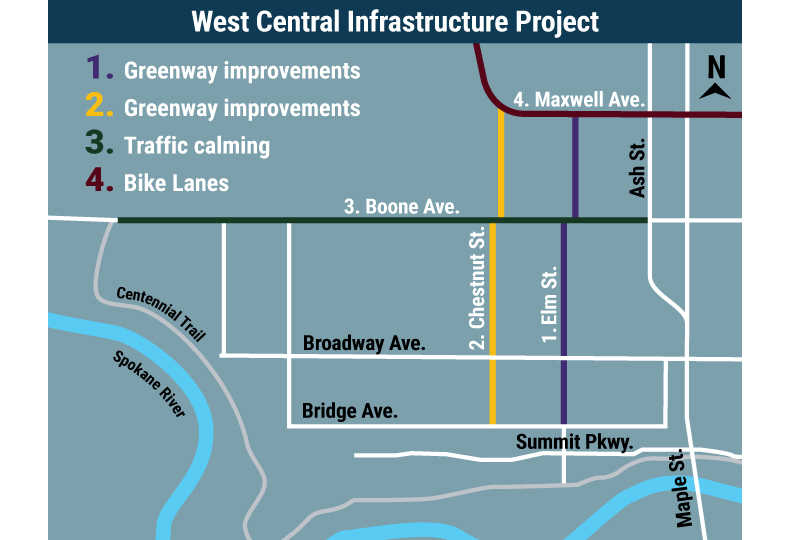
The first phase of improvements focused on a cluster of projects anchored on Elm Street, from the Centennial Trail going north to Maxwell Avenue, and eventually reaching Wellesley Avenue, Quinn-Hurst says. The improvements were designed to create a north-south spine through West Central, connect residential streets directly to the Centennial Trail, and serve as a core segment of the 27 by 2027 network, he says.
“This is really one of the first segments to be built of that network,” Quinn-Hurst says. “The idea is to use local neighborhood streets that are already great for walking and biking and connect those segments. … The most important step is to connect them with the safe crossings. This is really the foundation of building out that network.”
 —Abby Smith
 Improvements to the district last year were largely anchored on four main roads.
Designated as a neighborhood greenway — which are routes that prioritize safe walking and bicycling — improvements to the Elm Street greenway include wayfinding pavement markings that indicate bike and pedestrian paths, directional signs guiding users along the route, and traffic calming elements, such as striping and layout changes to slow vehicles.
Boone Avenue, which runs east-west from Monroe Street ending at the Centennial Trail and Spokane River connection, has had several street crossings and traffic calming improvements installed to reduce vehicle speeding, increase driver awareness, and make crossings safer for pedestrians and cyclists, Quinn-Hurst says. Improvements include curb extensions at Cochran, Chestnut, and Elm streets, as well as intersection crossing improvements at Summit Parkway.
“People used to just shoot straight down Boone,” Quinn-Hurst says.
Two blocks west of Elm Street, another designated greenway, Chestnut Street, runs north-south from near the Centennial Trail to Maxwell Avenue. Chestnut Street improvements are part of the same traffic calming and connectivity strategy and include sidewalk and crossing upgrades and other traffic calming features such as striping and lane narrowing.
About a half-mile north of Summit Parkway, work along Maxwell Avenue has helped close a critical gap in Spokane’s bike and pedestrian network, where existing bike lanes previously ended before reaching the Centennial Trail, explains Inga Note, senior traffic planning engineer with the city of Spokane.
New bike lanes have been installed, along with upgraded traffic signals, improved crosswalks, upgraded bus stops with platforms that extend out into the street, and road narrowing. Curb barriers have also been placed to protect the bike lane from traffic, Note adds.
“The idea there was to fill in the gap in our bike network,” Note says.
Reconnecting these routes highlights how the neighborhood's commuting needs are evolving.
As previously reported by the Journal, Spokane's West Central neighborhood is one of the oldest districts in the city, dating back to 1887 when it was originally platted, according to the West Central Infrastructure Project report. Over 75% of the homes in West Central were built between 1900 and 1912, when, at the time, the area was described as a “thriving, streetcar-connected suburb for the city’s middle class.” Faint traces of West Central's old streetcar tracks are still visible, embedded in the pavement.
At the southern end of West Central, Spokane's North Bank was once home to a Union Pacific Railroad switching yard. The 77-acre area was cleared in the 1970s and left vacant and contaminated from decades of railroad use. In an effort to transform the old railyard and revitalize the historic neighborhood, the city of Spokane created the West Quadrant Tax Increment Finance District in 2007. The finance district is split into two parts: the Kendall Yards subarea and the West Central Neighborhood Improvement area.
While Kendall Yards has transformed considerably over the past decade, the heart of West Central remains one of the most impoverished communities in Spokane and in Washington state. The infrastructure improvements will help residents get to their jobs, schools, grocery stores, and other destinations safely and efficiently, and provide a stronger foundation for economic development.
According to the project report, multimodal infrastructure is also good for business and encourages private investment. Compared to drivers, people who travel via other means spend more on average at restaurants, bars, and convenience stores each month. Additionally, when the city invests in multimodal infrastructure, it can signal to investors that a certain area is worth investing in.
2027 by 2027
So far, the most complete segment of the 27 by 2027 network system is in West Central, Quinn-Hurst says.
This year, the urban mobility network will be extended with projects on Adams Street at the intersection of Adams and Fifth Avenue and into the South Hill to 25th Avenue, he says. At 25th Avenue, the improvements will move half a block east to Jefferson Street and then continue south until reaching 27th Avenue, he adds. The downtown portion of Adams Street improvements will be completed at some point in the future. Additionally, traffic calming measures are planned on portions of Longfellow Avenue, between Belt and Cook streets on Spokane’s North Side.
Within two years, some additional high-traffic crossings will receive enhanced crosswalk signals featuring beacons and solid red lights, he says. Improvements along Longfellow Avenue will be funded by the Congestion Mitigation and Air Quality Improvement program.


Stay Informed. It’s Free.
Subscribe to our newsletters and get the latest news and insights delivered to your inbox.
We respect your privacy.
Unsubscribe anytime.
Thank you!
You’re subscribed. Keep an eye on your inbox for the latest updates.